
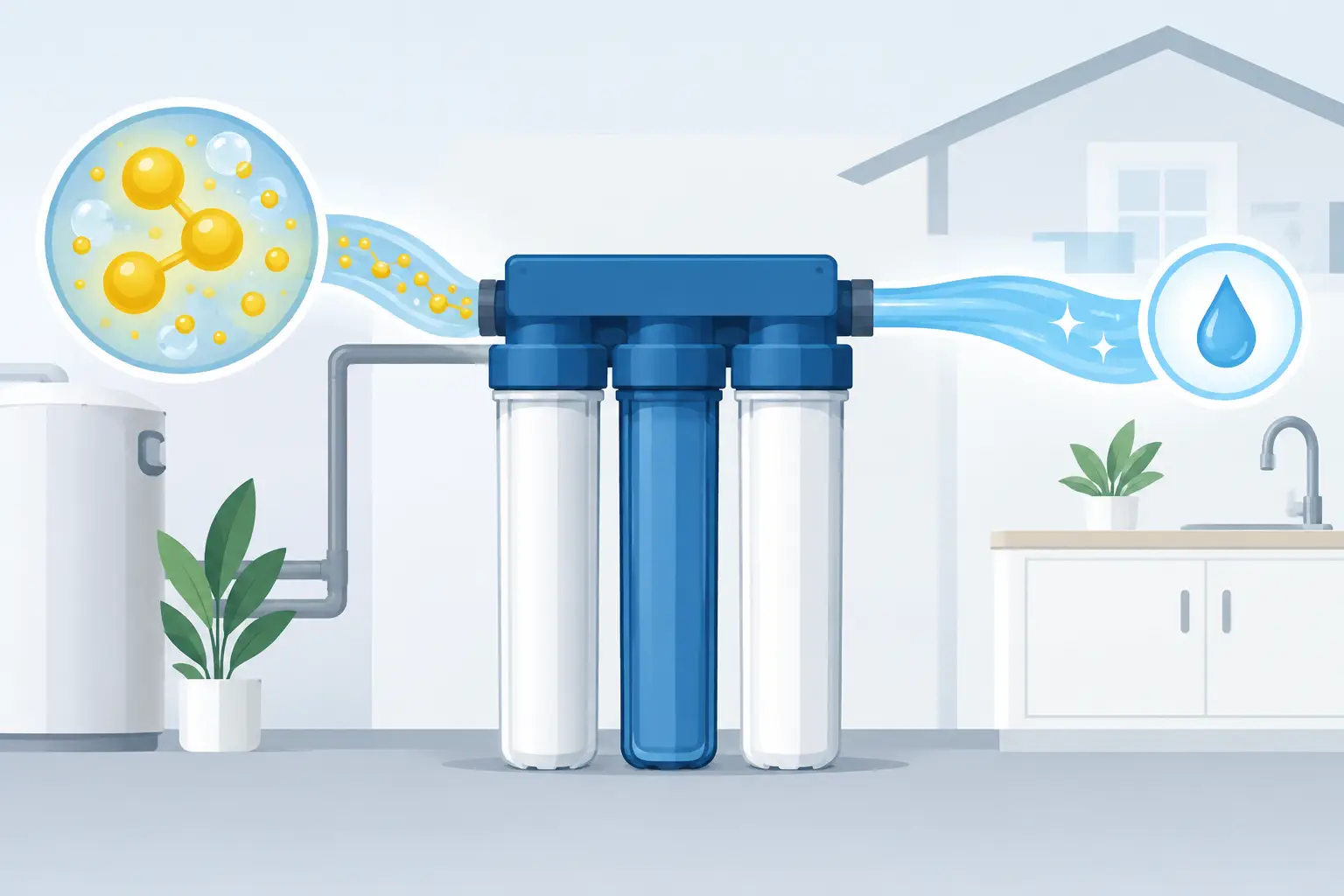
That sharp swimming-pool smell from the shower is often the first sign homeowners notice. So, do whole home filters remove chlorine? Yes, a properly selected and correctly sized whole-home filtration system can substantially reduce chlorine throughout the house, including at showers, bathroom sinks, laundry connections, and kitchen taps.
The key is that not every whole-home filter is built to do the same job. A basic sediment filter may protect plumbing from sand, rust, or grit, but it will not reliably remove chlorine. Effective chlorine reduction requires the right filtration media, enough media volume, sufficient contact time, and installation that matches the home’s water demand.
For Ontario families concerned about water taste, dry skin, chlorine odour, and protecting household plumbing and appliances, those details matter.
How whole home filters remove chlorine
Most municipal water systems add chlorine as a disinfectant. It helps control bacteria while water travels through distribution pipes to homes and businesses. It is an effective treatment method, but residual chlorine can leave water with an unpleasant taste or smell. Some people also find that chlorinated water contributes to dry-feeling skin and hair after bathing.
Whole-home chlorine filtration commonly relies on activated carbon. Carbon has a highly porous surface that attracts and holds chlorine compounds as water passes through the filter tank. This process is often called adsorption. Rather than merely masking the taste or odour, quality carbon media reduces the chlorine residual in the incoming water supply.
A whole-home system is installed at the main water line, usually after the water meter or pressure tank. This placement means treated water is delivered to every appropriate cold and hot-water fixture in the building. For households that want chlorine reduction in showers as well as drinking water, this is a more complete approach than relying only on a small filter at one kitchen faucet.
Activated carbon is not all the same
Standard activated carbon can be very effective for free chlorine when the system is properly designed. Catalytic carbon is often chosen when chloramine is present. Chloramine is a more stable disinfectant created by combining chlorine and ammonia, and it can be more difficult to remove than free chlorine.
Municipal treatment practices can vary by community and can change over time. Before recommending equipment, a water treatment professional should identify whether the water contains free chlorine, chloramine, or another concern that also needs attention. Choosing the wrong media can lead to disappointing results, even when the equipment itself is well made.
Do whole home filters remove chlorine at every tap?
They can, but performance depends on system capacity and water flow. A carbon filter needs time for water to move through the media bed. If a filter is too small for the home, water may pass through too quickly during high-demand periods, such as when multiple showers, a dishwasher, and a washing machine are running at once.
This is why filter sizing should never be based on price alone. A one-bathroom condo, a large family home with four bathrooms, and a commercial building have very different peak flow requirements. A system that performs well at a low flow rate may not deliver the same chlorine reduction when demand rises.
A properly engineered installation considers the incoming chlorine level, required flow rate, pipe size, water pressure, household occupancy, and desired service life. For commercial properties, it may also account for fixture counts, process water needs, occupancy patterns, and peak periods. The goal is consistent treated water, not just good results from a single glass of water drawn slowly from the kitchen tap.
What a chlorine filter can and cannot solve
Carbon filtration can make a noticeable difference to the way water tastes, smells, and feels. It can also help protect certain plumbing components and appliances from the effects of chlorinated water. However, chlorine reduction is only one part of water treatment.
A whole-home carbon filter does not automatically soften hard water. If your home has white scale on faucets, cloudy glassware, reduced water-heater efficiency, or frequent appliance maintenance, a water softener may be needed alongside chlorine filtration. In many Ontario homes, a combined treatment approach provides better long-term results than a single tank designed to handle every issue.
Likewise, carbon filtration is not a substitute for treatment designed for lead, bacteria, iron, sulphur, arsenic, manganese, or high sediment levels. Homes on private wells, lake water systems, or rural water supplies often need a more detailed water analysis because their water quality concerns are different from those found on municipal systems.
For drinking water, some homeowners choose to pair whole-home filtration with a reverse osmosis system at the kitchen sink. This combination provides chlorine-reduced water throughout the home while adding a dedicated high-purity drinking-water solution where it is most useful.
Signs your home may benefit from chlorine reduction
The most obvious sign is a chlorine or pool-like odour, especially when running hot water. Heat can make chlorine more noticeable, which is why many homeowners first notice it in the shower. Water that tastes chemical, tea that tastes off, or ice cubes with an unusual odour can also point to chlorine residual.
There are practical comfort concerns as well. Some people notice that their hair feels dry, their skin feels tight after showering, or laundry has a lingering chemical scent. These symptoms do not prove chlorine is the only cause, but they are reasonable reasons to assess the water supply.
In a home with hard water, the difference can be more pronounced. Hardness minerals create scale and soap residue, while chlorine affects taste and odour. Treating only one issue may leave the other unresolved. A professional assessment helps separate the problems and match the treatment system to the source.
Maintenance affects chlorine removal performance
Carbon media does not last forever. Over time, its adsorption capacity is used up. Once the media is exhausted, chlorine can pass through the tank with little reduction, even though water may still appear clear and the system may look normal from the outside.
Service life depends on the incoming chlorine concentration, total water use, filter size, and media type. A correctly sized system should be selected with a realistic maintenance schedule, not an optimistic estimate. Replacing media at the right time protects performance and helps avoid the return of chlorine taste and odour.
Sediment prefiltration can also be valuable where water contains visible particles or elevated turbidity. Sediment can coat carbon media and reduce its effectiveness. In some installations, a sediment filter, carbon tank, water softener, ultraviolet system, or reverse osmosis unit may be arranged in a specific order to protect each component and improve overall treatment results.
Regular service should include checking pressure, inspecting bypass settings, confirming that the system is operating as intended, and reviewing changes in water quality. If a municipality changes its disinfection method or your household water use increases, the original equipment may need adjustment or upgrading.
Choosing the right whole-home chlorine filter
The best system is not necessarily the largest tank or the least expensive option. It is the one designed around the actual water conditions and water demand at your property. A good recommendation begins with water testing or review of municipal water information, followed by an assessment of flow requirements and the issues you want to solve.
Ask whether the system is intended for free chlorine or chloramine, what flow rate it can support, how long the media is expected to last, and what ongoing maintenance is required. It is also worth asking how the installation will protect water pressure and whether the equipment can be serviced without disrupting the home’s entire water supply.
Canadian Smart Home Solutions helps Ontario homeowners and property managers evaluate water quality concerns and install whole-home systems that address the real cause of the problem. Whether the priority is chlorine taste, hardness scale, lead reduction, well-water odour, or a combination of concerns, the right design starts with understanding the water before choosing the equipment.
Cleaner water should feel straightforward: water that tastes better at the kitchen tap, smells better in the shower, and places less strain on the plumbing and appliances your property depends on.