
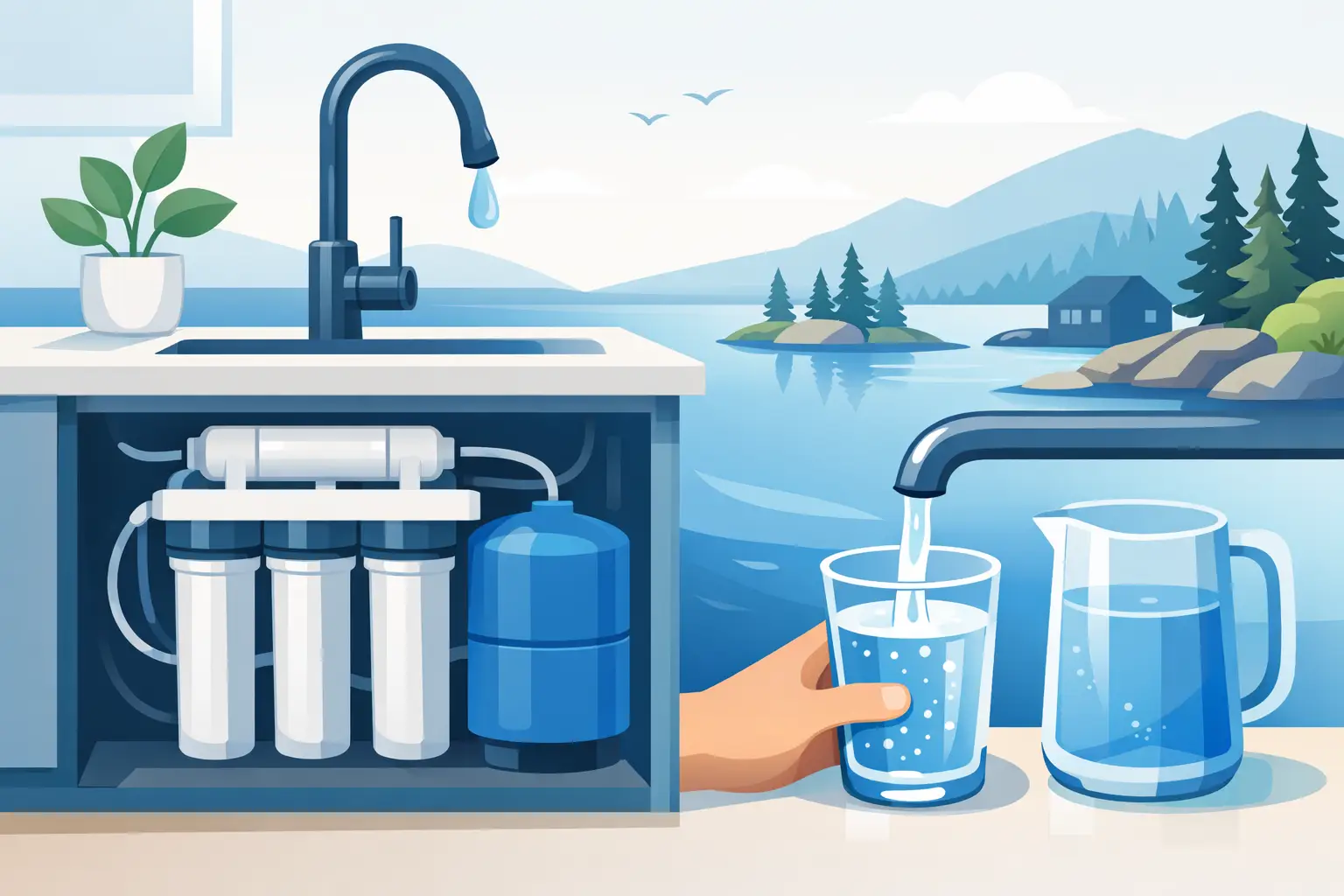
A glass of water can look perfectly clear and still carry concerns that matter to Ontario households: chlorine taste, lead from older plumbing, dissolved minerals, bacteria in private wells, or sediment released from aging pipes. The best under sink water purifiers address the contaminants actually present in your water, rather than relying on a one-size-fits-all filter.
An under-sink system treats water at the point where you drink and cook. It is usually installed inside the kitchen cabinet and supplies a dedicated drinking-water faucet, although some systems can connect to a compatible main faucet. For families who want better-tasting water without carrying bottled water home each week, it is a practical, space-saving solution. The right choice depends on your water source, plumbing, household needs, and test results.
What makes an under-sink purifier the right choice?
Under-sink filtration is designed for drinking water, food preparation, coffee, tea, and pet water. It does not replace a whole-home system when the problem affects every fixture in the house. If hard water is leaving scale on faucets, iron is staining toilets, or sulphur odours are noticeable in showers, treatment should begin at the main water supply.
That distinction saves money and frustration. A reverse osmosis system can produce excellent drinking water at one tap, but it will not protect a water heater, dishwasher, plumbing fixtures, or laundry from hard-water scale. Conversely, a whole-home filter may improve water throughout the house but may not reduce dissolved contaminants to the level a dedicated reverse osmosis system can achieve at the kitchen sink.
For many Ontario homes, the strongest approach is a whole-home treatment system for broad water-quality issues plus an under-sink purifier for refined drinking water. This is particularly common in homes on well water, lake water, or municipal water with a noticeable chlorine taste.
Best under sink water purifiers by water concern
Reverse osmosis for broad dissolved-contaminant reduction
Reverse osmosis, often called RO, is one of the most capable under-sink options. It pushes water through a semi-permeable membrane, reducing many dissolved substances that ordinary carbon filters do not reliably address. Depending on the system and the water chemistry, RO can reduce contaminants such as lead, sodium, fluoride, nitrates, and total dissolved solids, while also improving taste.
This makes RO a strong choice for homeowners concerned about older service lines, municipal water quality, or well-water contaminants identified through testing. A quality system normally uses several stages, including sediment and carbon pre-filtration to protect the membrane, followed by the RO membrane and a final polishing filter.
The trade-off is that RO systems need more cabinet space than a simple filter, require scheduled filter and membrane changes, and produce some reject water during purification. Modern high-efficiency designs can reduce waste compared with older equipment, but efficiency varies by model, incoming pressure, and water temperature. Homes with low water pressure may need a booster pump for reliable performance.
Carbon block filtration for chlorine, taste, and odour
A carbon block filter is often the best fit when the primary issue is chlorine taste, chloramine, unpleasant odour, or minor sediment in municipally supplied water. Carbon adsorption improves the taste of drinking water and can reduce many organic compounds, but performance depends on the specific filter media, contact time, and replacement schedule.
This option is generally less costly and simpler than reverse osmosis. It is well suited to households where water testing does not identify a concern requiring membrane treatment. However, a basic carbon filter should not be assumed to solve lead, nitrate, arsenic, bacteria, or high dissolved solids. The product’s performance claims need to match the problem you are trying to correct.
Lead-certified filtration for older Ontario plumbing
Lead is a concern worth taking seriously in older homes, particularly where lead service lines, brass components, or aging plumbing may be present. Water can pick up lead after it enters the property, which means a municipal treatment plant’s water quality report does not always reflect the water coming from your kitchen faucet.
For this concern, choose an under-sink system specifically certified for lead reduction, and have the water tested where possible. Both specialized carbon filters and reverse osmosis systems may be appropriate, but certification and correct installation matter more than a broad marketing label. Filter cartridges must also be replaced on time. An overdue cartridge can lose effectiveness long before water begins to look or taste different.
UV purification for bacteria and well-water risks
Ultraviolet systems disinfect water by exposing it to UV light. They are valuable when testing identifies bacteria or when a private well or lake-water supply has a microbiological risk. UV does not remove sediment, hardness, iron, chemicals, or dissolved minerals. In fact, cloudy water can reduce UV effectiveness because particles may shield microorganisms from the light.
For that reason, UV is often paired with sediment filtration and, in many well-water applications, broader pre-treatment. A point-of-use UV unit can support a kitchen drinking-water system, but a whole-home UV system is often more appropriate when bacteria could affect showers, bathroom taps, ice makers, and other fixtures.
How to choose between the best under sink water purifiers
Start with the source of your water. Municipal water and private well water present very different treatment needs. Municipal water may have disinfectant taste, sediment, or concerns related to local plumbing. Well water can vary widely from property to property and may contain hardness, iron, manganese, sulphur, bacteria, nitrates, or other naturally occurring substances.
A proper water test gives you a clear starting point. It prevents the common mistake of buying equipment for a problem you do not have while missing the one you do. For example, a carbon filter may make sulphur odour less noticeable at the kitchen tap, but it will not resolve iron staining or protect appliances. An RO system may reduce dissolved solids, yet it is not the first line of defence for heavy sediment or untreated bacterial contamination.
When comparing systems, assess these practical factors:
- The contaminants the system is certified or designed to reduce, based on your water test.
- Available cabinet space, drain access, water pressure, and whether a dedicated faucet is acceptable.
- Filter replacement intervals, membrane life, and the ongoing cost of maintenance.
- Daily water demand, especially for larger families, frequent cooking, or refrigerator and ice-maker connections.
- Whether a whole-home filter, softener, iron removal system, or UV treatment is needed before the under-sink unit.
Do not choose by filter stage count alone. More stages do not automatically mean better water. Each stage should have a defined role, such as sediment removal, chlorine reduction, membrane protection, dissolved-contaminant reduction, or final taste polishing.
Installation details that affect performance
Under-sink purifiers are compact, but their installation should not be treated as an afterthought. The system needs a sound cold-water connection, a properly installed drain saddle where required, sufficient clearance for cartridge changes, and a faucet mounted securely through the sink or countertop. Reverse osmosis systems also need the storage tank positioned where it can be serviced.
Poor installation can lead to leaks, low flow, premature filter wear, or a system that is difficult to maintain. This is especially relevant in condominiums, older homes, and properties with limited cabinet space or non-standard plumbing. Professional installation also helps ensure the system is selected and configured for the incoming water conditions rather than simply fitted beneath the sink.
Canadian Smart Home Solutions can assess water quality and recommend an under-sink system that works with, rather than against, your home’s existing treatment equipment. For homes with hardness, staining, odours, or well-water concerns, the recommendation may include a complete treatment plan instead of placing all expectations on a single kitchen filter.
Maintenance is part of clean drinking water
Every purifier has a service schedule. Sediment and carbon filters are commonly replaced more often than RO membranes, while UV lamps require regular replacement even if the light still appears to be working. The exact timing depends on the equipment, water use, sediment load, and the manufacturer’s instructions.
Keep a record of cartridge changes and sanitization service. If flow slows noticeably, taste changes, or the system has been unused for an extended period, arrange maintenance before assuming the unit is still performing as intended. Families using private wells should also retest their water periodically, particularly after flooding, nearby construction, changes in taste or odour, or work on the well or plumbing.
The best result is not simply a filter under the sink. It is a properly sized, professionally installed system maintained on schedule and chosen from real information about your water. That gives your household confidence every time the kitchen tap is turned on.