
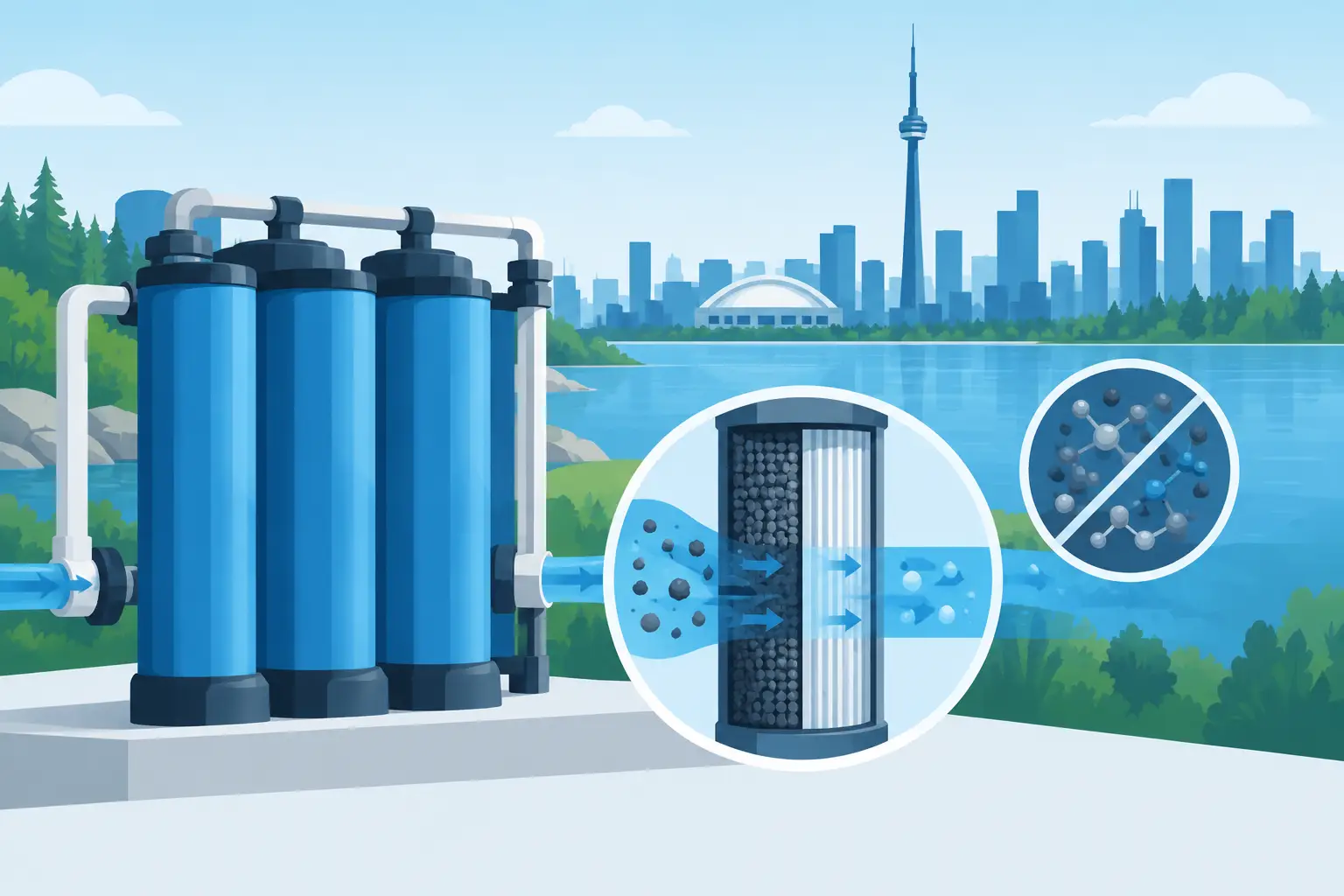
A glass of clear water can still carry contaminants that are impossible to see, smell, or taste. That is why PFAS filtration technology trends matter to Ontario homeowners, property managers, and facilities responsible for safe water. The question is no longer whether a filter improves taste. It is whether the treatment system has been properly selected, sized, installed, and maintained to reduce the specific PFAS compounds present in the water supply.
PFAS, often called “forever chemicals,” are a large group of manufactured substances used in products and processes that require resistance to water, grease, heat, or stains. They have become a growing concern because some PFAS can persist in the environment and may enter drinking water through industrial activity, landfill runoff, firefighting foam, wastewater, and contaminated groundwater.
For a home on municipal water, a private well, or a commercial property with its own supply, the practical response starts with water testing and a treatment plan based on real results.
Why PFAS Filtration Technology Trends Are Changing
The biggest change is a move away from one-size-fits-all water filters. PFAS treatment is more demanding than reducing chlorine taste or sediment. Different PFAS compounds can behave differently, and source-water conditions such as hardness, iron, organic matter, pH, and flow rate can affect filtration performance.
As a result, current system design is becoming more targeted. Homeowners are asking whether a kitchen drinking-water system is enough. Commercial and institutional facilities are looking at treatment capacity, peak demand, monitoring, service schedules, and how spent media will be handled. These are the right questions because a filter only performs as intended when it matches the water quality and the application.
Another important trend is greater attention to verification. Product claims should be supported by recognized performance testing for the contaminants a system is intended to reduce. A unit that is excellent for sediment, hardness, or bacteria is not automatically designed for PFAS reduction.
The Main Technologies Used for PFAS Reduction
No single technology is the right answer for every property. In many cases, the most dependable result comes from combining treatment stages, especially where water contains several issues at once.
Activated Carbon Remains a Leading Option
Granular activated carbon, commonly called GAC, is one of the most widely used options for reducing many PFAS compounds. Carbon works by adsorbing contaminants onto the surface of the media as water passes through. It can be used in a point-of-use drinking water filter, a whole-home system, or a larger commercial treatment vessel.
Carbon is familiar, effective, and adaptable, but it is not maintenance-free. Media capacity depends on the PFAS present, their concentration, water chemistry, contact time, and daily water usage. Once the carbon becomes exhausted, it must be replaced. Waiting until water tastes different is not a reliable maintenance strategy, since PFAS generally do not create a noticeable taste or odour.
For whole-home applications, proper sizing is particularly important. A small cartridge may suit a single drinking-water tap, while a family home or high-flow facility may require larger media tanks designed around actual demand.
Ion Exchange Offers High Capacity in the Right Conditions
Ion exchange resins are another important treatment option. Certain resins are engineered to attract and hold PFAS compounds, often providing strong performance and useful capacity for specific applications. They are increasingly considered for commercial, industrial, and high-use settings where a properly engineered system is needed.
The trade-off is that resin selection and operation require expertise. Competing contaminants, water quality changes, and flow conditions can influence performance. Spent resin also requires responsible handling. This is not a technology to select solely from a product label without reviewing the facility’s water analysis and operating needs.
Reverse Osmosis Focuses on Drinking Water
Reverse osmosis, or RO, is a practical choice for many households that want high-quality water at a kitchen sink or dedicated drinking-water tap. An RO system uses a semi-permeable membrane to reduce a broad range of dissolved contaminants, including many PFAS, while also improving taste.
RO is generally a point-of-use solution rather than a whole-home PFAS system. It is well suited for water used for drinking, cooking, coffee, ice, and infant formula. It does not usually make sense to use RO for every shower, toilet, laundry load, or outdoor tap because it produces water more slowly and requires a dedicated installation.
Pre-filtration matters with reverse osmosis. Sediment, chlorine, hardness, iron, and other source-water issues can shorten membrane life or reduce performance. A properly designed system may include sediment filtration, carbon filtration, softening, or other pre-treatment before the RO unit.
Multi-Barrier Systems Are Becoming More Common
One of the most practical trends is the use of multi-barrier treatment. Instead of expecting one component to solve every water problem, the system is built in stages. For example, a rural property may need sediment removal and iron treatment before carbon or RO filtration. A hard-water home may benefit from softening to protect downstream equipment. A commercial facility may need pre-filtration, PFAS treatment media, storage, and monitoring equipment to maintain consistent flow.
This approach helps protect the PFAS treatment stage from fouling and addresses the issues customers experience every day, including staining, odours, scale buildup, appliance wear, and poor-tasting water.
Whole-Home Treatment or Point-of-Use Filtration?
The best location for PFAS treatment depends on the risk assessment, intended use, budget, plumbing layout, and water demand. For many municipal-water households, point-of-use reverse osmosis at the kitchen sink is a sensible starting point when the priority is drinking and cooking water.
A whole-home solution may be appropriate where water testing, exposure concerns, or property requirements justify treating all incoming water. Whole-home treatment can also be valuable where a property has multiple water quality concerns that should be addressed at the main supply. However, treating every litre of water costs more and requires equipment that can maintain pressure and flow during busy periods.
For schools, hotels, healthcare environments, multi-residential buildings, and industrial facilities, the decision is more complex. Water use can vary sharply throughout the day, and interruptions are not always acceptable. These projects should be engineered around peak flow, water testing, maintenance access, redundancy where necessary, and local plumbing requirements.
Monitoring and Media Change-Out Are Part of the System
A PFAS filter is not a permanent set-it-and-forget-it product. The current direction in water treatment is toward clearer service planning: knowing what media is installed, when it was placed in service, how much water has passed through it, and when replacement or testing is due.
For a residential system, this may involve scheduled cartridge changes and periodic water testing. For commercial equipment, it can include flow meters, pressure monitoring, sampling points, documented service records, and planned media replacement. These details protect performance and help avoid the risk of running a system beyond its useful capacity.
Disposal is also receiving more attention. PFAS is captured by treatment media rather than destroyed by most conventional filtration systems. The used carbon, resin, or membrane therefore needs to be managed through an appropriate service and disposal process. Responsible treatment includes planning for this step before the system is installed.
What Ontario Property Owners Should Do First
The right first step is not to buy the largest filter available. Start with a professional water analysis that considers the source of the water and the full range of concerns. For a private well, this may include bacteria, iron, manganese, sulphur, hardness, and other groundwater conditions alongside PFAS testing. For municipal water, the focus may be on PFAS, lead, chlorine, hardness, and the household’s intended water use.
Then match the equipment to the results. Ask what PFAS compounds the proposed system is designed to reduce, how the equipment is sized, what flow rate it can support, what maintenance it needs, and how replacement media will be handled. A clear answer to these questions is more valuable than a broad claim that a filter provides “pure water.”
Canadian Smart Home Solutions helps Ontario homeowners and facilities assess their water, select practical treatment equipment, and install systems built around real water conditions. The goal is not unnecessary complexity. It is dependable water treatment that protects the people, plumbing, appliances, and operations that rely on it.
PFAS concerns can feel difficult because the contaminant cannot be seen and the technology is evolving. A tested water source, correctly matched equipment, and a documented maintenance plan turn that uncertainty into a practical next step.