A white crust on the kettle, an egg-like smell from the shower, orange marks in the toilet, or water that simply tastes off are not problems to guess at. The right way to test tap water is to identify what is actually present, where it enters your plumbing, and whether it affects health, comfort, or equipment.
For Ontario homeowners, water quality can vary considerably between municipal supplies, private wells, lake water systems, and even neighbouring properties. A proper water analysis replaces uncertainty with a clear treatment plan – whether that means a water softener, reverse osmosis drinking-water system, UV sterilizer, iron filter, or a complete whole-home solution.
When Should You Test Tap Water?
Test your water when you notice a change in colour, taste, smell, staining, or soap performance. It is also sensible to test after moving into a home, completing plumbing work, replacing a well pump, flooding near a well, or installing a treatment system that has not been checked recently.
Private well owners should test more routinely. Wells are not treated and monitored in the same way as municipal water supplies, so water conditions can shift with rainfall, groundwater movement, nearby land use, septic system issues, or changes to the well itself. Bacterial testing is particularly important for households supplied by a well, lake, or cistern.
Municipal water is generally treated before it reaches the distribution system, but that does not answer every question inside a home. Older service lines and plumbing fixtures can contribute lead or other metals. Hardness, chlorine taste, and dissolved minerals may also affect how water feels, tastes, and performs even when it meets regulatory standards.
What to Test Tap Water For
The right panel depends on the water source and the problem you are trying to solve. Testing for everything without a purpose can add cost without giving a clearer answer. A focused analysis gives better information for choosing equipment that is properly sized and effective.
Health and safety concerns
For drinking-water safety, common concerns include bacteria, lead, nitrates or nitrites, arsenic, and other metals or contaminants relevant to the water source. Bacteria testing is essential when water comes from a private well, lake, cistern, or other untreated source. Cloudiness, recent flooding, repeated gastrointestinal illness in the household, or a damaged well cap are all reasons to act quickly.
Lead deserves particular attention in older Ontario homes. It may come from a lead service line, solder, or fixtures rather than the water source itself. Because lead levels can be affected by how long water has sat in the pipes, the sampling instructions matter. A first-draw sample, taken after water has remained unused for a specified period, can show what residents may be exposed to from household plumbing.
Water that damages fixtures and appliances
Hard water contains dissolved calcium and magnesium. It is not usually a health concern, but it can leave scale on faucets, reduce soap lather, spot dishes, dry skin and hair, and shorten the working life of water heaters, dishwashers, coffee machines, and boilers. A hardness result indicates whether a water softener is appropriate and helps determine its capacity and settings.
Iron and manganese can leave orange, brown, black, or grey staining on sinks, laundry, toilets, and fixtures. Sulphur can cause a rotten-egg odour. Low pH may contribute to corrosive water and blue-green staining from copper plumbing, while high pH can influence scale formation and treatment performance.
These are not interchangeable issues. An ordinary sediment filter will not solve hardness, and a water softener is not designed to correct bacterial contamination. The analysis must lead the recommendation.
Aesthetic and performance concerns
Chlorine taste or odour, sediment, cloudiness, and unpleasant taste are common reasons to consider filtration. Activated carbon can improve taste and reduce chlorine in many situations, while reverse osmosis provides highly refined drinking water at a dedicated kitchen tap. Turbidity testing may be especially useful for well and lake water because particles can interfere with other forms of treatment, including UV disinfection.
How to Collect a Reliable Water Sample
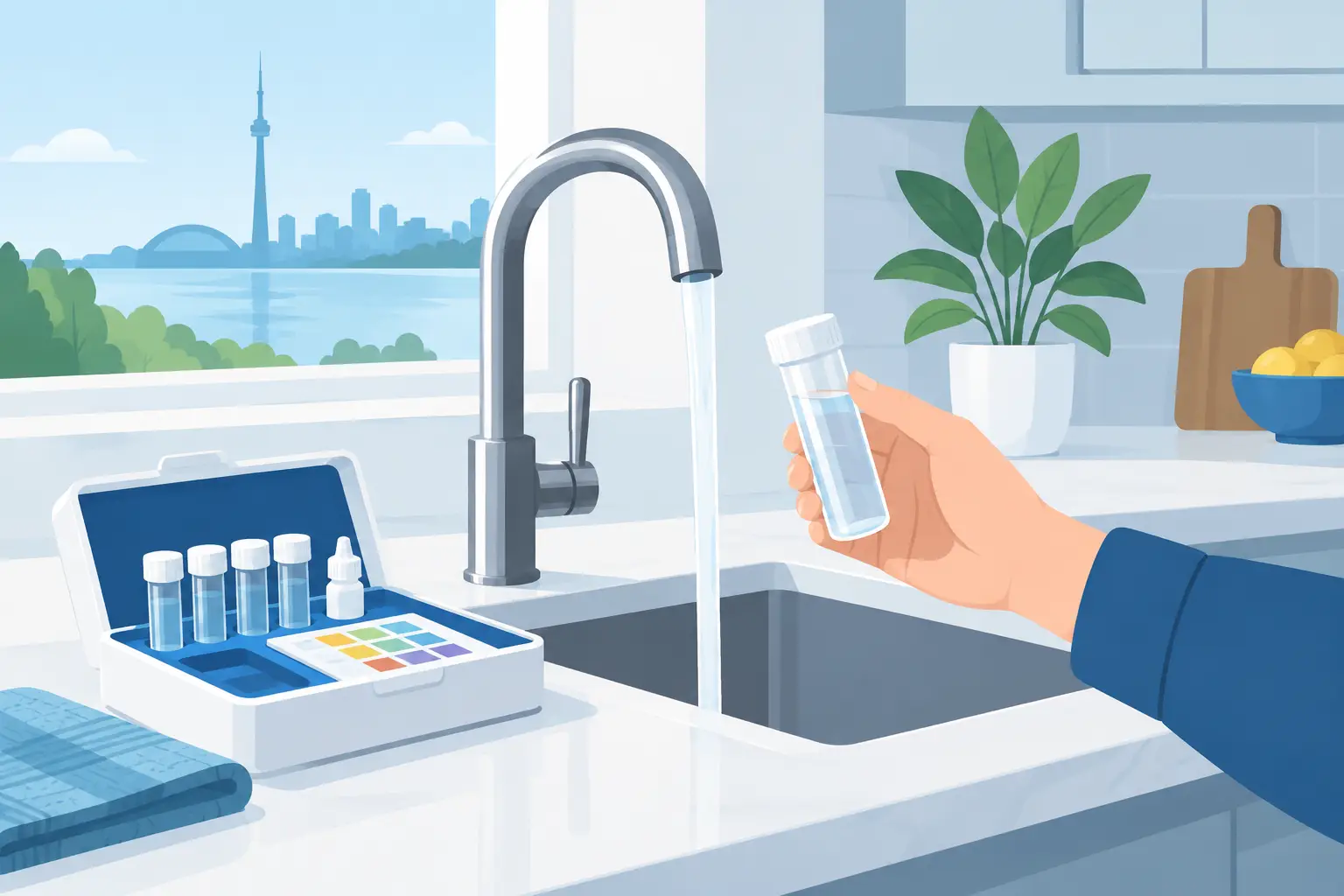
A lab result is only as useful as the sample. Before collecting water, decide what question you are trying to answer. If the concern is household drinking water, sample from the cold-water kitchen tap, ideally from a faucet that is used for drinking and food preparation. Do not sample from a tap connected to a filter unless you specifically want to assess that filter’s performance.
Follow the laboratory’s sampling instructions exactly. Some tests require the tap to run for several minutes before filling the bottle. Others, particularly lead testing, may require a first-draw sample after the water has sat unused. Bacteria bottles often contain a preservative and must not be rinsed. Touching the inside of the cap or bottle can compromise the sample.
For bacteria testing, avoid using a faucet with a swivel screen, aerator, hose attachment, or visible buildup if the instructions advise against it. Fill the container carefully, leave the required air space, keep it cool if directed, and deliver it within the lab’s stated time limit. A late sample can produce an unreliable result.
If you are assessing a well, it may also be useful to inspect the source. Check that the well cap is secure, the casing is intact, surface water drains away from the well, and there are no obvious sources of contamination nearby. Testing identifies what is in the water. A site assessment can help explain why it is there.
Understanding Your Water Test Results
Water reports can look technical, but the key is to separate findings into three practical categories: health-related concerns, nuisance problems, and treatment design factors. A qualified water treatment professional can explain how the results work together rather than focusing on one number in isolation.
For example, hardness may be reported in grains per gallon or milligrams per litre. Either unit can be used to size a softener, but the system must also account for household water use, peak flow demand, iron levels, and available installation space. Choosing a unit based only on a basic hardness reading can lead to insufficient capacity or unnecessary salt use.
Similarly, UV systems are highly effective for disinfection when they are correctly sized and the water is clear enough for ultraviolet light to pass through. If the water has sediment, colour, iron, or turbidity, pre-treatment may be needed before the UV unit. Reverse osmosis can reduce many dissolved contaminants at the drinking-water tap, but it is not a substitute for correcting a serious whole-home water issue.
If a test identifies bacteria, lead, arsenic, or another potential health concern, use a suitable alternative drinking-water source until you have clear guidance and an effective corrective plan. Retesting after installation or corrective work confirms that the solution is performing as intended.
Matching Treatment to the Result
There is no single best filter for every Ontario property. Municipal homes with hard water and chlorine taste may benefit from a whole-home softener paired with carbon filtration and reverse osmosis for drinking water. A rural well may require sediment removal, iron and sulphur treatment, softening, and UV sterilization in a specific order.
Commercial and institutional properties need the same disciplined approach on a larger scale. A hotel managing scale in hot-water equipment, a school concerned about drinking-water quality, or a healthcare facility requiring reliable high-flow treatment should begin with source testing, flow requirements, and the building’s water-use profile. Equipment must be engineered for demand, not selected as though it were serving a single household.
Canadian Smart Home Solutions uses water testing and on-site assessment to recommend systems based on actual conditions, plumbing requirements, and the outcome that matters most – safer drinking water, reduced scale, odour control, stain prevention, or dependable treatment throughout the property.
Retest After Treatment and Over Time
Installation should not be the final step. Retest after a new system is commissioned to confirm it is addressing the original concern. For ongoing performance, follow the service schedule for filters, UV lamps, softener settings, and other consumable components. A neglected system can gradually lose effectiveness even if the water still looks clear.
The retesting interval depends on the source and the risk. Private wells require regular bacteria screening and periodic broader testing. Municipal-water homes may retest after plumbing changes, if a lead concern exists, or whenever a noticeable change in water quality occurs. For commercial sites, scheduled monitoring helps protect equipment, maintain service continuity, and document water quality practices.
Good water treatment starts with an accurate sample, not an assumption. If your water is leaving stains, building scale, carrying an odour, or raising questions about what your family is drinking, a properly planned test is the practical first move toward a solution that will last.