
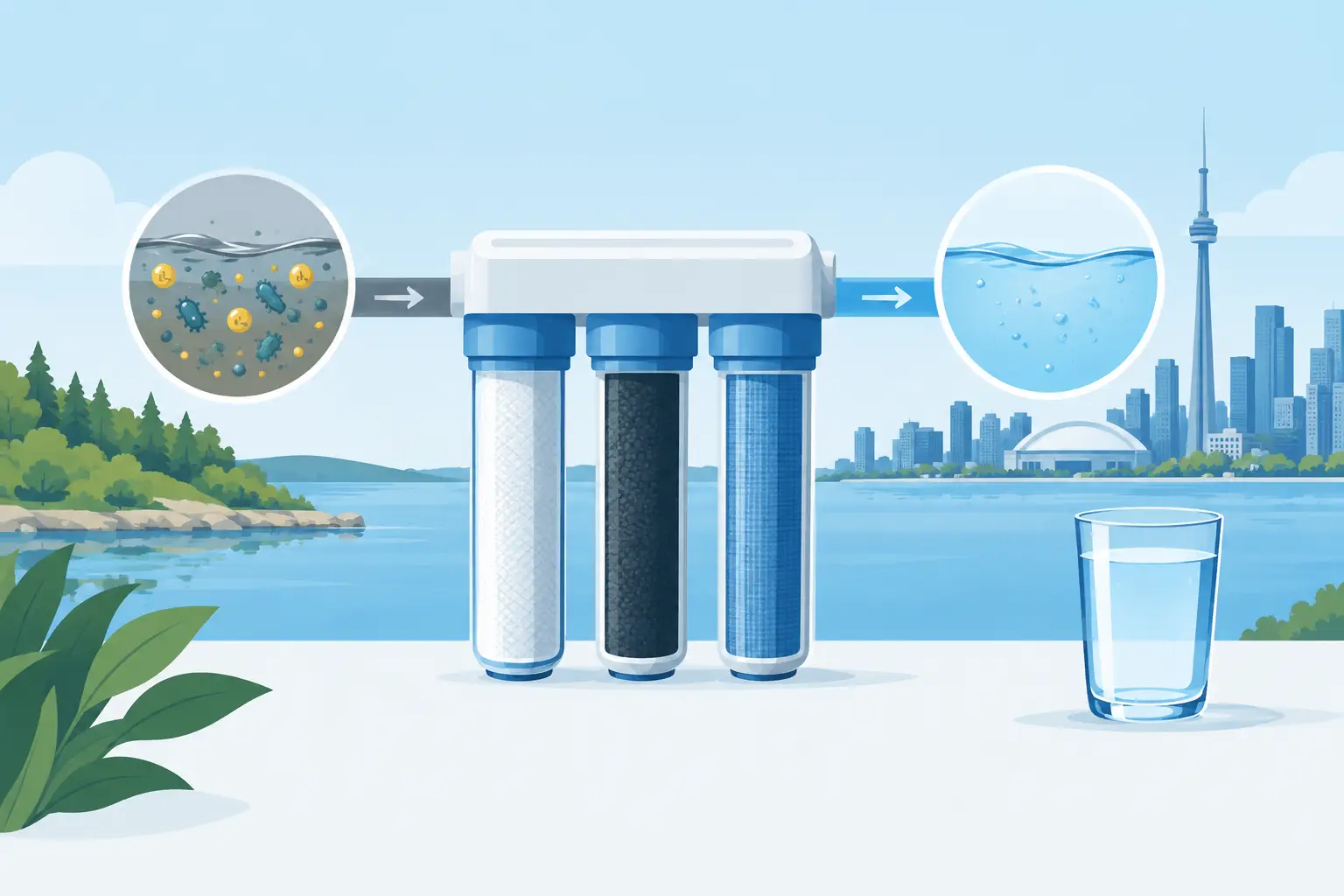
A glass of municipal water can meet safety requirements and still smell like a public pool. That familiar odour, the sharp taste in coffee, dry skin after a shower, and faded laundry often lead Ontario property owners to ask about chlorine removal methods. The right answer depends on where the chlorine is causing problems, how much water the property uses, and whether the water contains free chlorine or chloramine.
Chlorine is commonly used by municipal water systems to control bacteria as water travels through pipes. That disinfectant residual serves a purpose, but many homeowners and businesses prefer to reduce it at the tap, in the shower, or throughout the building. Effective treatment should improve water quality without sacrificing flow rate, creating unnecessary maintenance, or overlooking other concerns such as lead, hardness, iron, or sulphur.
Why chlorine in water deserves a practical solution
For many households, chlorine is primarily a taste and odour issue. Water may taste harsh on its own and affect tea, coffee, soups, and ice. Chlorinated water can also contribute to dry-feeling skin and hair for some people, particularly when showering frequently.
The issue can be larger in commercial settings. Hotels, salons, fitness facilities, multi-unit properties, restaurants, and care facilities use substantial volumes of water every day. If occupants notice an unpleasant chlorine smell or taste, a small point-of-use filter is rarely enough. Treatment must be sized for peak demand so that water quality and pressure remain consistent.
Chlorine is not the same as chloramine. Chloramine is a more stable disinfectant made by combining chlorine and ammonia, and some water utilities use it to maintain a residual over long distribution lines. Standard carbon filtration can reduce both, but chloramine generally requires more contact time and often benefits from catalytic carbon. Identifying the disinfectant before selecting equipment prevents disappointing results.
Chlorine removal methods that work
Activated carbon filters
Activated carbon is the most widely used option for reducing chlorine taste and odour. Its porous media attracts and holds many compounds as water passes through it. Carbon filtration is available in refrigerator filters, countertop units, under-sink systems, shower filters, and larger whole-home tanks.
For drinking water at one kitchen sink, a quality carbon block filter can be a sensible, cost-effective choice. Carbon block media generally provides finer filtration than loose granular activated carbon, but cartridges have a limited service life. Delaying replacement can reduce performance and flow.
For whole-home treatment, a backwashing carbon tank or a large cartridge system treats water before it reaches showers, appliances, and fixtures. This is often the better solution for families who want chlorine reduction throughout the house. The system must be selected according to household size, incoming chlorine level, plumbing configuration, and peak flow rate. An undersized tank may perform adequately at a low-flow bathroom tap but allow chlorine breakthrough when several showers, appliances, or fixtures run at once.
Catalytic carbon for chloramine
Catalytic carbon is specially processed carbon that can be more effective for chloramine reduction than conventional activated carbon. It is a strong option where a municipal supply uses chloramine or where testing confirms that standard carbon treatment is not achieving the expected improvement.
This is not a case of simply choosing the most expensive media. Water flow, contact time, and tank sizing remain critical. In a high-demand home or commercial facility, properly engineered catalytic carbon treatment is usually more dependable than a small filter that promises broad performance without enough media volume.
Reverse osmosis for drinking water
Reverse osmosis systems are installed at a dedicated drinking-water faucet, usually beneath the kitchen sink. They typically combine sediment prefiltration, carbon filtration, a membrane, and post-filtration. The carbon stages reduce chlorine because chlorine can damage many reverse osmosis membranes. The membrane then reduces a wide range of dissolved contaminants beyond chlorine, depending on the system and water conditions.
Reverse osmosis is an excellent choice when the goal includes better-tasting drinking water and reduction of specific dissolved substances. It is not, however, a replacement for whole-home chlorine treatment. It supplies a smaller volume of purified water for drinking and cooking, not every shower, laundry load, or appliance in the building.
Shower filters
A shower filter can reduce chlorine exposure at one shower without modifying the home’s plumbing system. It may suit renters, secondary bathrooms, or households that want a targeted improvement first. Results vary by filter media, water temperature, flow rate, and the type of disinfectant present.
Shower filters are convenient, but they should not be treated as a whole-home solution. They do not improve drinking water, protect all fixtures, or address chlorine at other showers and sinks. Replacement schedules matter here as well, since an exhausted cartridge cannot continue to perform as intended.
Point-of-entry filtration for the entire property
A point-of-entry system is installed where water enters the home or building. It is the most complete approach when chlorine odour is noticeable throughout the property or when the goal is to improve water for bathing, cleaning, cooking, and appliance use.
A properly designed whole-home carbon system can be installed on its own or as part of a broader treatment train. For example, homes with hard water may use sediment filtration, carbon filtration, and a water softener in the appropriate order. Properties with well water may require iron, manganese, sulphur, or bacteria treatment first, based on a complete water analysis. Each component should solve a confirmed issue rather than add unnecessary equipment.
What will not reliably remove chlorine
Not every water treatment device is designed for chlorine reduction. A water softener exchanges hardness minerals such as calcium and magnesium, but it does not replace a carbon filter for chlorine removal. In fact, chlorine can be hard on certain softener components over time, so carbon prefiltration may be beneficial in a municipally supplied home with a softener.
Ultraviolet systems disinfect water using light, but they do not remove chlorine, chloramine, sediment, or dissolved chemicals. UV can be valuable for wells, lake water systems, and applications requiring disinfection, yet it addresses a different problem.
Boiling can reduce some free chlorine because chlorine is volatile, but it is inefficient for household use and far less reliable for chloramine. Letting water sit uncovered may also lessen a chlorine smell, though it is not a practical treatment plan for a family or business. Water pitchers can help at the drinking-water level if they contain suitable carbon media, but their capacity and flow are limited.
How to choose the right system
Start with the water source. Municipal water usually calls for chlorine or chloramine reduction, while private wells and lake-water supplies require testing for a broader range of concerns. Water that smells like chlorine may still contain hardness, lead from plumbing components, or other quality issues that need separate treatment.
Next, define where improvement is needed. An under-sink carbon or reverse osmosis system may be enough if the concern is drinking water only. If showers irritate skin, laundry carries an odour, or the entire property has a noticeable disinfectant smell, whole-home carbon filtration is usually the more appropriate route.
Finally, consider demand and maintenance. A small household can often use a compact system, while a large home, restaurant, school, or care facility needs equipment engineered for its required flow rate. Media type, tank size, valve capacity, filter-change intervals, installation location, drainage requirements, and local plumbing codes all affect long-term performance.
Why water testing and professional sizing matter
Water treatment is most effective when it is based on actual conditions, not assumptions. A water assessment can help distinguish chlorine from chloramine and identify whether sediment, hardness, iron, lead, or other factors may affect system selection. It also helps establish the correct treatment order.
Canadian Smart Home Solutions designs and installs residential, commercial, and industrial water treatment systems for Ontario properties with real-world water challenges. For a whole-home chlorine system, installation quality matters as much as the filter media. Proper bypasses, shut-off valves, service access, and flow sizing make future maintenance straightforward and help ensure the system delivers the expected result.
If chlorine is making water unpleasant, begin with a clear goal: better-tasting drinking water, more comfortable showers, building-wide odour reduction, or a complete treatment plan. From there, a tested and correctly sized system can turn a persistent water complaint into a dependable everyday improvement.