A glass of water can look perfectly clear while still carrying a problem that affects your family, plumbing, or peace of mind. The real question in a uv purifier vs reverse osmosis decision is not which system is better in general. It is which contaminant is present in your water and where you need treatment.
For Ontario homeowners, the answer often depends on whether water comes from a municipal supply, a private well, or a lake-based system. UV purification and reverse osmosis solve different problems. One targets living microorganisms. The other reduces a wide range of dissolved contaminants that can affect taste, health, and water quality.
UV Purifier vs Reverse Osmosis: The Core Difference
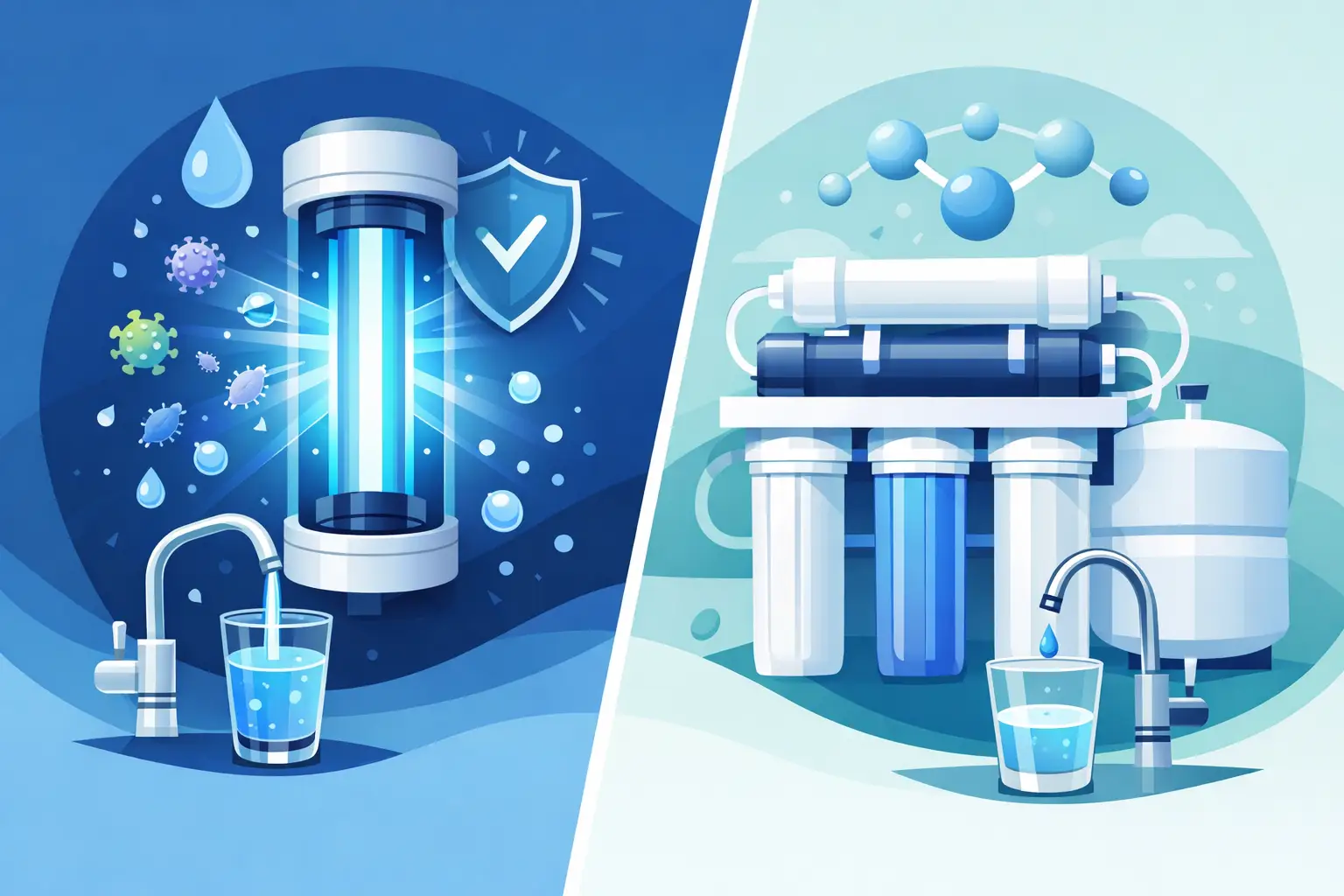
A UV purifier uses ultraviolet light to disinfect water. As water passes through the chamber, UV light damages the genetic material of microorganisms such as bacteria, viruses, and parasites, preventing them from reproducing. It does not add chemicals to the water and does not change its taste.
Reverse osmosis, commonly called RO, uses water pressure to push water through a very fine membrane. That membrane reduces many dissolved substances, including lead, sodium, nitrates, fluoride, minerals, and contaminants that can create unpleasant taste or odour. Most residential RO systems are installed at a kitchen sink to provide high-quality drinking and cooking water.
Put simply, UV is a disinfection solution. RO is a filtration solution for dissolved contaminants. Neither is a universal substitute for the other.
What a UV Water Purifier Handles Well
UV systems are a strong choice when microbiological safety is the main concern. This is especially relevant for private wells, cottages, rural properties, lake water systems, and facilities where water may be exposed to bacterial contamination.
A properly sized UV sterilizer can treat all water entering a home, providing whole-home protection at the point where water enters the building. That means water used for drinking, brushing teeth, bathing, ice makers, and washing can be disinfected before it reaches fixtures and appliances.
UV treatment has practical advantages. There is no chemical dosing, no added chlorine taste, and no regeneration cycle. The system can operate continuously with relatively simple upkeep: replacing the UV lamp on schedule and cleaning or replacing the quartz sleeve when needed.
However, UV light does not remove sediment, iron, hardness, sulphur odours, pesticides, lead, or dissolved minerals. It also needs clear water to work effectively. Cloudiness, sediment, iron, and tannins can shield microorganisms from the UV light. For this reason, a well-designed UV installation often includes sediment filtration and, where required, iron or tannin treatment ahead of the UV chamber.
What Reverse Osmosis Removes
Reverse osmosis is most useful when the concern is what is dissolved in the water rather than what is alive in it. For homes supplied by municipal water, an RO system is often chosen to improve drinking water quality at one tap. It can substantially reduce lead, chlorine by-products, sodium, many dissolved solids, and other contaminants depending on the system design and the source water.
This makes RO particularly valuable for families concerned about older plumbing, lead exposure, salty or mineral-heavy water, or bottled-water costs. It also improves the taste of drinking water, tea, coffee, soups, and ice because the membrane and prefilters reduce many taste-causing substances.
A typical under-sink RO system includes prefilters, a membrane, a storage tank, and a dedicated drinking-water faucet. The prefilters protect the membrane, while post-filtration can improve the final taste of the water.
RO does have trade-offs. It produces a separate stream of concentrate water as part of the purification process, so it uses more water than a standard carbon filter. Filters and membranes need scheduled replacement, and production is slower than water flowing directly from a regular faucet. RO also does not solve hard-water scale throughout the house, because it is usually a point-of-use system rather than a whole-home treatment system.
Which System Is Right for Municipal Water?
For most municipal water customers in Ontario, a reverse osmosis system is the more direct answer for better drinking water. Municipal water is normally disinfected before it reaches your property, but it can still contain chlorine, chloramine, dissolved minerals, and contaminants picked up through service lines or household plumbing.
If lead is a concern, an RO system designed for lead reduction can be an effective part of the solution at the drinking-water tap. Water testing and an assessment of the plumbing are still important, particularly in older homes where lead service lines or fixtures may be present.
A UV purifier may be appropriate on municipal water in specialized situations, such as a property with a private storage system, a building with plumbing conditions that create elevated microbiological risk, or a commercial application requiring an additional disinfection barrier. For the average city home, though, UV alone will not improve chlorine taste or reduce lead and dissolved contaminants.
Which System Is Right for Well Water?
Well water requires a more careful approach because every well has its own chemistry and contamination risk. A UV system is often a key final treatment stage after the water has been clarified. If testing shows bacteria or there is a risk of surface water entering the well, UV provides dependable ongoing disinfection without relying on chemical treatment.
But a UV system should not be installed as a guess. If the well water contains sediment, iron, manganese, sulphur, hardness, or tannins, those issues need to be addressed first. Iron staining on fixtures, rotten-egg odours, scale inside water heaters, and cloudy water are signs that a complete treatment train may be needed.
Reverse osmosis can still have a role with well water, usually at the kitchen sink. It is useful where testing shows nitrates, high sodium, elevated dissolved solids, or concerns about specific dissolved contaminants. In many homes, the strongest setup is a whole-home well water treatment system for the incoming supply, UV disinfection for safety, and RO at the kitchen for purified drinking water.
When Combining UV and RO Makes Sense
Choosing between UV and RO is sometimes the wrong starting point. Properties with several water-quality concerns often benefit from both systems because each protects against a different category of risk.
A common example is a rural Ontario home with a private well. Sediment filtration and iron treatment may protect equipment and clear the water. A water softener may reduce scale and protect plumbing, fixtures, and appliances. A UV purifier can then disinfect the treated household water. Finally, an RO system at the kitchen tap can reduce dissolved contaminants and provide excellent drinking water.
Commercial and institutional properties may need the same layered approach at a larger scale. Schools, nursing homes, hotels, healthcare facilities, and food-service operations often require systems engineered around flow rate, water demand, source-water quality, and maintenance requirements. A small residential UV unit or under-sink RO system cannot simply be scaled up without proper design.
Do Not Choose Based on Taste Alone
Better-tasting water is a welcome result, but it should not be the only deciding factor. Clear, odour-free water can still contain bacteria, nitrates, lead, or other dissolved substances. On the other hand, a water test may show that an expensive treatment system is unnecessary for your specific supply.
The most reliable starting point is water testing followed by a practical review of the property. Consider the water source, test results, plumbing age, household size, flow requirements, existing equipment, and the symptoms you are trying to solve. A family concerned about lead at the kitchen tap has different needs than a country home dealing with iron staining and bacterial risk.
Canadian Smart Home Solutions helps Ontario homeowners and facilities match treatment equipment to the actual problem, from whole-home filtration and UV sterilizers to drinking-water RO systems. Proper sizing and installation matter as much as the equipment itself, particularly when water quality affects health, appliances, or building operations.
Clean water should not rely on assumptions. Test the source, identify the risk, and choose a system that protects the water you use every day.