
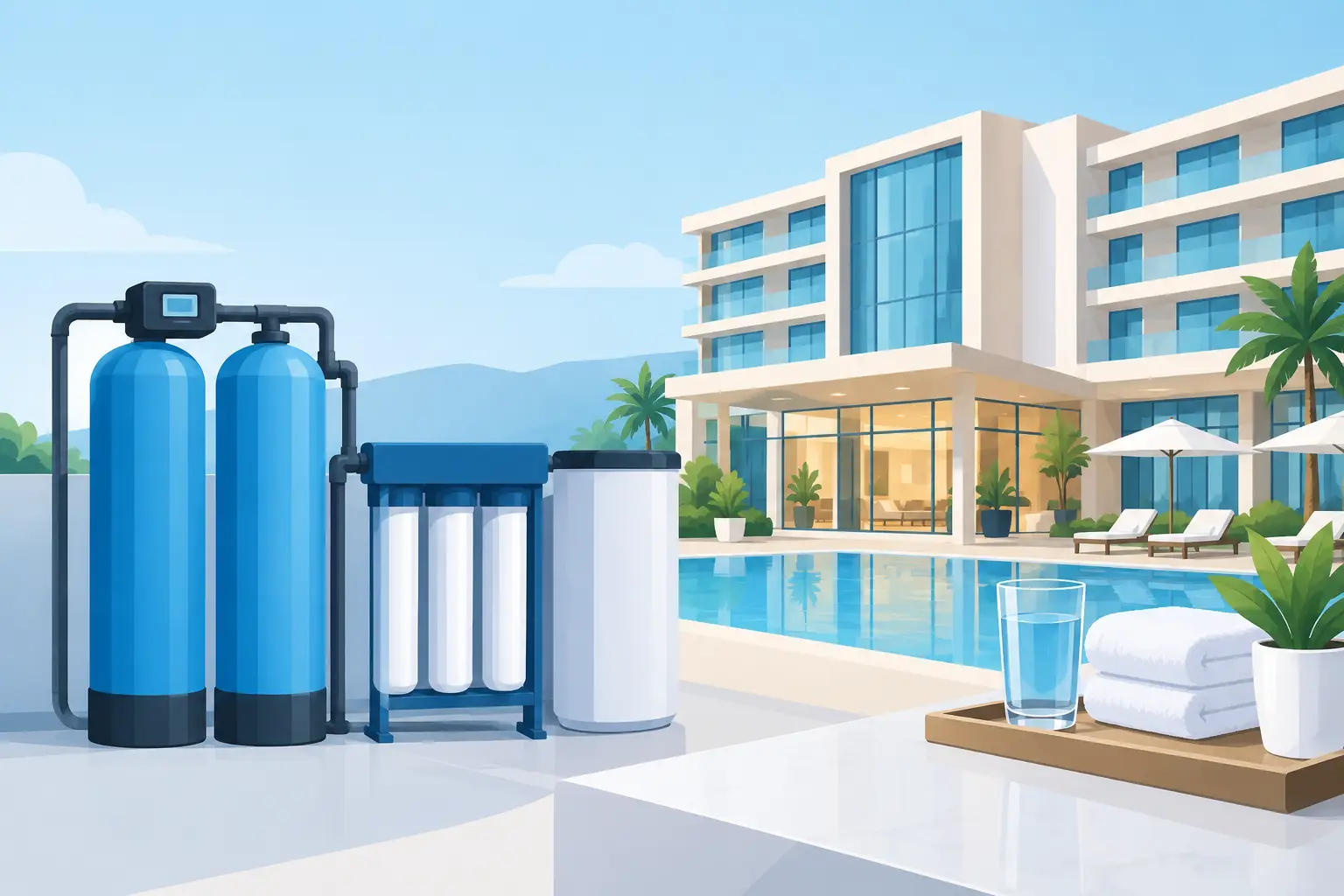
A guest may never ask what is in the water, but they will notice the effects. White scale on showerheads, spotting on glassware, a sulphur smell in a washroom, dry-feeling linens, or poor-tasting drinking water can all affect the stay they remember. The best water treatment for hotels is not one standard piece of equipment. It is a properly sized system designed around the building’s water source, guest capacity, plumbing layout, and daily peak demand.
For hotel owners, operators, and facility managers, water treatment is also an asset-protection decision. Hard water and untreated contaminants can shorten the service life of boilers, water heaters, dishwashers, ice machines, laundry equipment, faucets, and fixtures. The right treatment plan improves water quality while reducing avoidable maintenance, cleaning time, energy waste, and equipment downtime.
Start With a Water Analysis, Not a Product
The first question is not whether a hotel needs a water softener, reverse osmosis unit, or UV system. The first question is what the water contains and how the hotel uses it.
Municipal water in Ontario is treated before it reaches the property, but it can still contain hardness minerals, chlorine or chloramine, sediment, iron from aging plumbing, and trace contaminants that affect taste, appearance, and equipment performance. Hotels on private wells or lake water systems require more detailed analysis because water quality can change by season and may involve bacteria, iron, manganese, sulphur, turbidity, tannins, or other source-specific concerns.
A professional water test should assess the concerns that matter most for the property: hardness, iron, manganese, pH, total dissolved solids, turbidity, odour, bacteria where applicable, and any contaminants identified through site conditions or plumbing history. It should also consider flow rate. A system that produces excellent water in a lab result but cannot keep up with breakfast service, laundry cycles, housekeeping, and occupied-room showers is not an effective commercial solution.
Best Water Treatment for Hotels: Build a System Around the Problem
Most hotels benefit from a combination of treatment technologies rather than a single filter. Each component has a distinct job, and the correct sequence matters.
Sediment filtration protects downstream equipment
Sediment filters remove suspended particles such as sand, rust, silt, and debris. They are particularly valuable for properties with well water, older plumbing, storage tanks, or variable source water. Removing sediment early protects control valves, softener resin, UV systems, membranes, ice machines, and other equipment that can be damaged or clogged by particulate matter.
For a hotel, the filter must be selected for commercial flow. Small cartridge filters may work at a single point of use, but they can create pressure loss and require frequent changes when used as the main treatment stage for a large building. Backwashing media filters or properly designed multi-cartridge systems are often more practical for higher demand.
Water softeners control scale and operating costs
Hardness is one of the most common and costly hotel water issues. Calcium and magnesium create scale inside water heaters, boilers, dishwashers, coffee equipment, steam equipment, showerheads, and plumbing fixtures. The visible signs are frustrating, but the hidden effects are often more expensive: reduced heat-transfer efficiency, higher energy use, restricted water flow, premature equipment failure, and increased service calls.
A commercial water softener exchanges hardness minerals for sodium or potassium ions. For most hotel applications, a properly sized softener is the foundation of equipment protection. It can also improve soap performance, reduce spotting on dishes and glassware, help laundry detergents work more effectively, and make washrooms easier to maintain.
Sizing is critical. A hotel should not be fitted with a residential-style softener simply because it has a large tank. The system needs enough resin capacity and service flow to meet peak demand without hard-water breakthrough. Twin alternating systems are often a strong choice because one unit can remain in service while the other regenerates. This helps maintain a continuous supply of softened water in properties that operate around the clock.
Carbon filtration improves taste, odour, and guest comfort
Activated carbon filtration is commonly used to reduce chlorine taste and odour, as well as certain organic compounds. In hotels supplied by municipal water, carbon can noticeably improve drinking water, ice, coffee, and food preparation while reducing the chemical smell some guests notice in showers or at taps.
Carbon media must be sized for adequate contact time, not just installed as a token filtration stage. High flow can move water through undersized carbon too quickly to achieve meaningful reduction. Carbon also requires maintenance and should be protected from excess sediment to prevent fouling.
UV sterilization provides added protection for private water sources
Ultraviolet sterilization is often recommended for hotels using well water, lake water, or other non-municipal sources where bacteria and other microorganisms are a concern. UV systems disinfect water as it passes through the chamber without adding chemicals.
However, UV is not a cure-all. It does not remove hardness, iron, sediment, or sulphur. Water must be clear enough for the UV light to work effectively, which is why prefiltration is essential. A commercial UV system should also include monitoring features so staff can confirm that the lamp and system are operating as intended. For properties with complex source-water concerns, treatment design may need to include additional disinfection or storage measures based on the water analysis and applicable requirements.
Iron, manganese, and sulphur treatment solves staining and odours
Orange or brown staining points to iron. Black staining may indicate manganese. A rotten-egg odour is commonly associated with hydrogen sulphide or sulphur bacteria. These problems can quickly become visible to guests in sinks, toilets, showers, laundry, and ice equipment.
The correct solution depends on concentration, pH, water chemistry, and flow requirements. Oxidation and filtration systems, specialized media filters, aeration, or chemical injection may be appropriate. Guessing can lead to poor results, so this is an area where water testing and site-specific system design are especially valuable.
Reverse osmosis is best where drinking-water quality matters most
Reverse osmosis, or RO, is highly effective for producing clean, better-tasting water at a dedicated point of use. In a hotel, it is often an excellent choice for kitchen drinking-water taps, staff break areas, executive floors, bottle-filling stations, coffee service, or premium guest amenities.
Whole-building RO is possible in specialized situations, but it is not automatically the best choice for every hotel. It requires careful engineering, pre-treatment, storage, drainage planning, and maintenance. For many properties, treating the full building with filtration and softening, then installing RO where people drink or prepare food, delivers the right balance of performance and cost.
Design for Peak Demand and Service Continuity
Hotels experience sharp water-demand changes. Morning showers, housekeeping, kitchen service, laundry operations, banquet events, and fitness facilities can all create high-flow periods. A treatment system must be sized for the maximum expected service flow, not average daily consumption.
The design should account for the number of rooms, occupancy patterns, restaurants or bars, commercial kitchens, laundry volume, boilers, pools or spas, meeting spaces, and future expansion. Pressure loss through filters, softeners, and plumbing must also be considered. Poor sizing can leave upper floors with weak pressure or allow untreated water through during peak use.
For larger properties, redundancy is often worth the investment. Duplex softeners, parallel filtration tanks, duty-and-standby UV equipment, bypass lines, isolation valves, and monitoring controls make maintenance easier and reduce the chance that a single component disrupts operations. Bypass arrangements should be designed carefully so service can continue while protecting sensitive equipment whenever possible.
Maintenance Is Part of the Treatment Plan
Commercial water treatment is not install-and-forget equipment. Filter media, cartridges, UV lamps, softener brine systems, control valves, and RO membranes all require scheduled attention. The exact schedule depends on water quality, usage, and equipment type.
A proactive service plan helps hotel teams avoid emergency calls and makes performance easier to verify. Staff should know where the bypass valves are, what normal pressure readings look like, when salt delivery is required, and who to contact if alarms appear. Periodic water testing is equally useful, particularly for private water sources or buildings where water conditions have changed.
Canadian Smart Home Solutions designs and installs commercial water treatment systems for high-demand properties, with equipment selected to address the actual water conditions rather than a one-size-fits-all package.
A hotel does not need to treat every drop of water in the same way. It needs a practical system that protects its equipment, supports its staff, and gives guests clean, dependable water at every point that matters.