
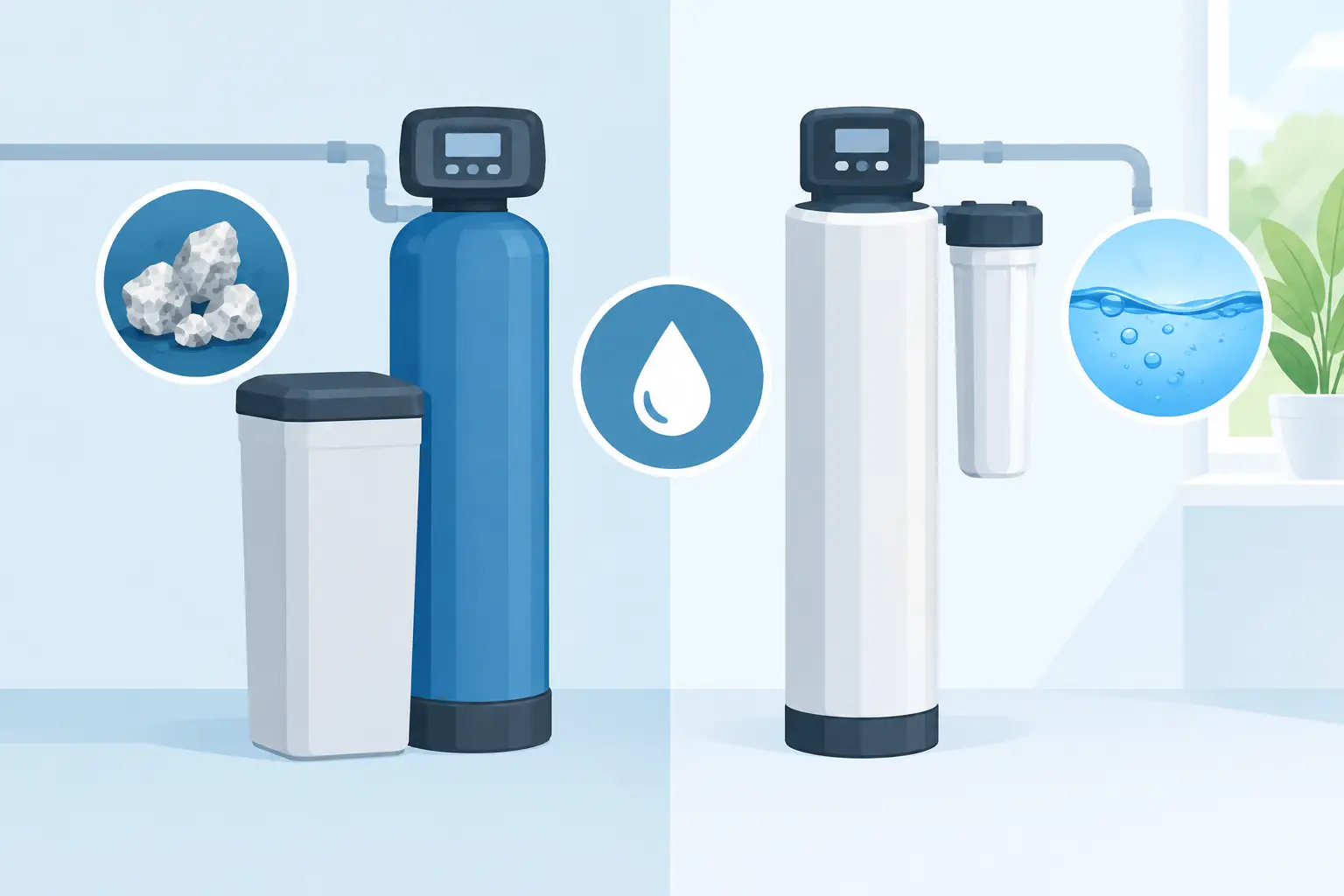
Hard-water scale on a kettle is one thing. Scale inside a water heater, dishwasher, boiler, or plumbing system is a more expensive problem. When comparing a water softener versus conditioner, the key question is not which unit sounds better. It is whether you need to remove hardness minerals or simply reduce the way those minerals form scale.
For Ontario homeowners, the answer often depends on the source of water, hardness level, household water use, existing equipment, and the specific issues appearing around the home. A water conditioner may be a sensible choice in some situations. But where hard water is causing persistent buildup, dry skin, stained fixtures, reduced appliance efficiency, and frequent cleaning, a properly sized water softener is usually the more complete solution.
Water softener versus conditioner: the key difference
A conventional water softener removes hardness minerals from water. A water conditioner generally leaves those minerals in the water but aims to change how they behave.
Hard water contains dissolved calcium and magnesium. These minerals are not usually a drinking-water health concern, but they create practical issues. As water is heated or evaporates, calcium and magnesium can form scale on fixtures, shower glass, heating elements, and the internal components of appliances.
A softener uses ion exchange. Water passes through resin beads that attract calcium and magnesium, replacing them with sodium or potassium ions. The result is genuinely softened water, with substantially lower hardness.
Most salt-free conditioners use a different method, often called template-assisted crystallization. The media encourages hardness minerals to form microscopic crystals that are less likely to stick to surfaces. This can reduce scale accumulation under suitable water conditions, but the calcium and magnesium remain present. The water will still test as hard.
That distinction matters. A conditioner is not a direct substitute for a softener in every home, even when both products are marketed as scale-control equipment.
What a water softener does well
A water softener is designed for homes or facilities dealing with moderate to severe hardness. It provides the most noticeable improvements where hardness is the main problem.
Softened water helps prevent hard scale from building up in water heaters, tankless heaters, dishwashers, washing machines, coffee machines, humidifiers, and plumbing fixtures. This can improve the efficiency of equipment that heats water and reduce the frequency of descaling or service calls.
Many families also notice everyday changes. Soap and shampoo rinse more easily, laundry can feel softer, glassware develops fewer spots, and bathrooms require less scrubbing. These are practical benefits, especially in homes with several bathrooms, high hot-water demand, or appliances that have already begun to show scale damage.
A softener does require periodic regeneration. During this cycle, the system uses salt or potassium chloride and a measured amount of water to rinse accumulated hardness minerals from the resin. Modern demand-initiated systems regenerate according to actual water use, which is more efficient than relying on a fixed timer.
The trade-off is ongoing maintenance. Salt must be added, the brine tank should be checked, and the system needs professional sizing and setup. Improperly sized equipment can waste salt and water or fail to keep up with household demand.
What a water conditioner can and cannot do
A water conditioner can be a useful option when the goal is scale management without salt, regeneration cycles, or a drain connection. Because it does not use brine, it generally requires less routine attention than an ion-exchange softener.
Conditioners can be attractive for homes where water hardness is relatively low to moderate, where drainage is difficult to install, or where the owner wants a low-maintenance approach to reducing scale on plumbing and appliances. They may also suit certain commercial applications where reducing mineral adhesion is the primary objective.
However, expectations need to be realistic. A conditioner does not remove calcium or magnesium. It will not produce the same soap performance as softened water, and it may not stop spotting or scale under all water conditions. It also does not remove sediment, iron, sulphur odours, lead, chlorine, bacteria, pesticides, or other contaminants.
Water chemistry can affect conditioner performance. High iron, manganese, sediment, or certain pH conditions may require pretreatment. On private wells, for example, treating iron, sulphur, bacteria, or sediment before installing scale-control equipment is often necessary for dependable results.
Which system is right for your Ontario home?
The right choice starts with the problem you are trying to solve. If the issue is heavy white buildup on taps and shower doors, a water heater that needs frequent descaling, stiff laundry, poor soap lather, and appliance wear, a water softener is typically the stronger long-term answer.
If your water has manageable hardness and your priority is reducing scale with minimal maintenance, a conditioner may be worth considering. It can be a practical fit when there is no convenient drain for a softener or when salt-free operation is a firm preference.
Municipal water and well water should be evaluated differently. Municipal water may contain chlorine or chloramine, which can affect taste, odour, and the lifespan of some treatment media. Well water can vary widely in hardness, iron, manganese, sulphur, sediment, pH, and bacteria. A conditioner or softener alone may not address all of those issues.
For well-water properties, treatment often works best as a coordinated system. Sediment filtration, iron and sulphur removal, softening, ultraviolet disinfection, and reverse osmosis may each have a role depending on laboratory results. Installing a single device without identifying the full water profile can leave the original problem only partially solved.
Consider sodium, water use, and installation requirements
Some homeowners hesitate to install a softener because of sodium. Ion-exchange softeners add sodium in proportion to the water hardness removed. For most households, the contribution is modest, but people following medically restricted sodium diets should discuss their needs with a healthcare professional.
Potassium chloride can be used instead of sodium chloride in many systems, although it is usually more expensive. Another common approach is to soften the whole home while supplying an unsoftened cold-water line to a dedicated drinking-water tap. A reverse osmosis drinking-water system can also reduce dissolved solids at the point of use.
Drainage and local installation conditions also matter. A softener needs access to water, power, and an appropriate drain for regeneration discharge. Professional installation helps ensure the system has correct bypass plumbing, flow capacity, backflow protection where required, and settings matched to the home’s actual hardness and occupancy.
For commercial buildings, selection becomes even more site-specific. A hotel, school, healthcare facility, or multi-unit property may need high flow rates, duplex softeners for continuous service, or engineered pretreatment equipment. In these settings, choosing based on price alone can lead to poor pressure, insufficient capacity, and preventable downtime.
Do not confuse softening with filtration
A softener protects against hardness, but it is not a complete water filtration system. Likewise, a conditioner is primarily a scale-management device, not a purifier.
If your concerns include chlorine taste, sediment, lead, odours, well-water bacteria, or contaminants in drinking water, additional treatment may be needed. A whole-home carbon filter can address chlorine and many odours. An ultraviolet system can provide disinfection for properly pretreated water. Reverse osmosis can improve drinking water at a dedicated tap, while specialized media can target iron, sulphur, manganese, or lead.
This is why water testing matters. A hardness reading alone does not reveal whether your water has iron, elevated sodium, acidity, bacterial risk, or contaminants that require separate treatment. A professional review of water results, plumbing layout, flow requirements, and household use produces a recommendation that fits the property rather than a generic sales pitch.
Make the decision based on results you need
Choose a water softener when you want hardness minerals removed and need reliable protection from heavy scale. Choose a conditioner when your goal is lower-maintenance scale control and your water chemistry is suitable for that technology.
Before committing to either option, have the water tested and look beyond the visible scale. The best system is the one that protects your plumbing and appliances, supports the quality of water your family uses every day, and addresses the actual conditions coming into your home.