
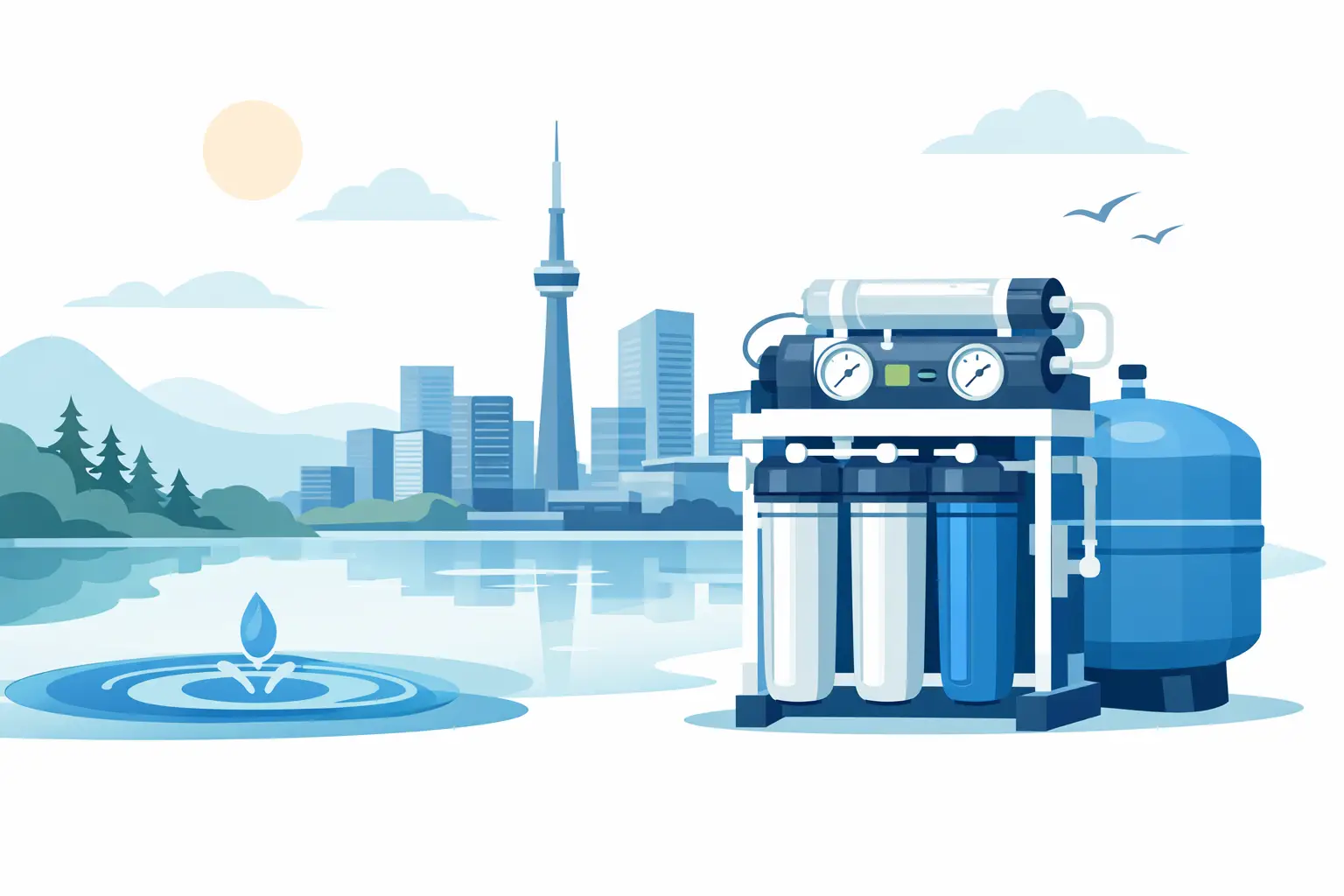
A hotel that runs out of purified water at breakfast, a school dealing with poor-tasting drinking water, or a manufacturer facing scale inside process equipment all have the same problem: water quality is affecting daily operations. The best commercial reverse osmosis systems address that problem with properly sized equipment, effective pretreatment, dependable controls, and professional installation. The right system is not simply the one with the highest production rating. It is the one engineered around your water source, demand pattern, space, drainage, and treatment goals.
What a Commercial RO System Actually Does
Reverse osmosis, often called RO, uses pressure to push water through a semi-permeable membrane. The membrane separates many dissolved contaminants from the product water, including salts, minerals, lead, and other dissolved solids. The result is cleaner, lower-mineral water for drinking, food service, steam equipment, process use, humidification, spot-free rinsing, and other applications where water quality matters.
An RO system produces two water streams. Permeate is the treated water delivered to a storage tank or directly to the point of use. Concentrate is the water carrying away rejected dissolved material and is directed to drain or, where appropriate, managed through a designed recovery approach.
That distinction matters because commercial RO design is about more than filtration. A system must produce enough permeate at the required quality while accounting for feed-water temperature, incoming pressure, drain capacity, operating hours, and expected membrane recovery. A unit that looks adequate on paper can fall short during peak demand if those details are ignored.
Choosing the Best Commercial Reverse Osmosis Systems
The best fit depends on what the water will do for your facility. A small office providing drinking water has very different requirements from a nursing home, restaurant, hotel laundry, laboratory, or manufacturing operation. Start with the intended use, then work backwards into capacity and treatment design.
Capacity Must Match Peak Demand
Commercial RO capacity is commonly expressed in gallons per day, but daily production alone is not enough. A facility may use modest volumes overall yet require a large amount of purified water in a short window. A café may need water quickly during morning service. A hotel may see concentrated demand in its kitchen, ice machines, and beverage stations. A production line may need a steady, uninterrupted supply.
Storage is often the practical answer. An RO system can replenish a correctly sized atmospheric tank over time, while a delivery pump provides high flow when the building needs it. This approach prevents the system from being oversized solely to handle short demand spikes. It also adds a useful operational buffer when usage is variable.
For larger facilities, duplex or multi-membrane configurations can provide greater output and redundancy. Redundancy costs more up front, but it can be worthwhile where loss of treated water would interrupt patient care, food service, production, or tenant services.
Water Testing Comes Before Equipment Selection
No commercial system should be selected without reviewing the incoming water. Municipal water and well water can both contain conditions that affect performance. Hardness, iron, manganese, chlorine or chloramine, turbidity, silica, sulphur odours, bacteria, and total dissolved solids can all influence the treatment train.
For example, hard water can form scale on RO membranes, reducing production and increasing cleaning requirements. Iron and manganese can foul membranes. Chlorine can damage many standard thin-film composite membranes unless it is removed first. Well water may also require disinfection and specialized filtration before it reaches the RO equipment.
A proper water analysis identifies these risks before installation. It also helps establish realistic expectations for treated-water quality and ongoing maintenance. At Canadian Smart Home Solutions, commercial recommendations are built around the actual water problem rather than a one-size-fits-all package.
Pretreatment Protects the Membranes
Membranes are the working core of an RO system, but pretreatment is what keeps them productive. In many commercial applications, the system may include sediment filtration, carbon filtration, a water softener, iron or sulphur removal equipment, ultraviolet treatment, antiscalant dosing, or a combination of these components.
The correct sequence depends on the feed water. Carbon filtration is commonly used on chlorinated municipal supplies to protect membranes and improve taste and odour. Water softening may be necessary where hardness is high. On well water, specialized iron removal or oxidation treatment may be needed ahead of the RO system.
Cutting pretreatment to reduce the initial price is a false economy. Membrane replacement, downtime, reduced flow, and frequent service can quickly cost more than installing the right protection at the beginning.
Features That Matter in Commercial RO Equipment
A commercial RO system should be built for the environment in which it will operate. That means selecting quality membranes and vessels, reliable pumps, appropriate pressure gauges, flow meters, automatic flushing, and controls that allow staff or service technicians to see how the equipment is performing.
Conductivity monitoring is particularly valuable because it tracks dissolved solids in the product water. A change in conductivity can indicate membrane wear, incorrect blending, or another operating issue before it becomes a larger problem. Tank level controls, low-pressure cut-offs, leak protection, and automatic shutdown functions also help protect the equipment and reduce unnecessary waste.
For facilities with limited mechanical-room space, layout matters just as much as the equipment itself. A wall-mounted skid may suit one application, while a floor-mounted system with storage tanks, pumps, and pretreatment vessels may be better for another. Access for filter changes, membrane service, salt delivery, drain connections, and electrical work should be planned before the system arrives.
Commercial RO Is Not Always the Complete Solution
Reverse osmosis is highly effective for dissolved contaminants, but it does not replace every other water treatment process. If a facility has bacterial concerns, UV disinfection or another approved disinfection method may be required. If the concern is whole-building hardness, an RO system serving a drinking-water line will not protect all plumbing fixtures, boilers, dishwashers, and water-using appliances from scale.
Likewise, RO creates lower-mineral water that may be ideal for certain processes but unnecessary for every tap in the building. Treating only the water needed for drinking, beverage equipment, ice machines, laboratory use, or a specific process can be more cost-effective than trying to supply RO water throughout a large property.
Some applications also need post-treatment. Remineralization can improve the taste of drinking water, while UV treatment after storage can add protection in systems with tanks and distribution piping. Blending may be used where a specific water quality target is required. These choices should be based on the use of the water, not assumptions.
Installation, Service, and Operating Costs
A commercial RO purchase should include a plan for installation and support. Plumbing connections, electrical requirements, drain routing, floor space, ventilation, and local code compliance all need to be considered. In Ontario, commercial properties often have complex mechanical spaces and operational restrictions, making professional site assessment especially valuable.
Operating cost is influenced by feed-water quality, recovery rate, incoming pressure, water temperature, filter changes, membrane life, and the volume of concentrate sent to drain. Higher recovery can reduce water waste, but pushing recovery too far can increase scaling and membrane fouling. The right setting is a balance between efficiency and reliable operation.
Routine service should include checking pressures and flows, changing prefilters, reviewing conductivity, sanitizing storage where appropriate, inspecting pumps and controls, and replacing membranes when performance declines. Keeping records helps identify gradual changes before they become an emergency. Facilities that depend on treated water should also keep critical replacement filters and service contacts readily available.
Questions to Ask Before You Buy
Before approving a system, ask whether the proposal is based on a current water test and actual peak demand. Confirm what pretreatment is included, where treated water will be stored, how much drain water the system will produce, and who will service it after installation. You should also ask what happens if demand increases, a pump fails, or incoming water quality changes.
A dependable supplier should be able to explain the treatment sequence in plain language, identify the maintenance responsibilities, and size the equipment for your facility rather than offering a generic package. This is especially important for schools, healthcare settings, hospitality properties, and businesses where poor water quality can affect safety, customer experience, or equipment life.
The most effective commercial RO project starts with clear information: a water test, a site review, and an honest understanding of how your facility uses water. With those details in hand, you can install a system that delivers consistent treated water, protects valuable equipment, and gives your team one less operational problem to manage.