
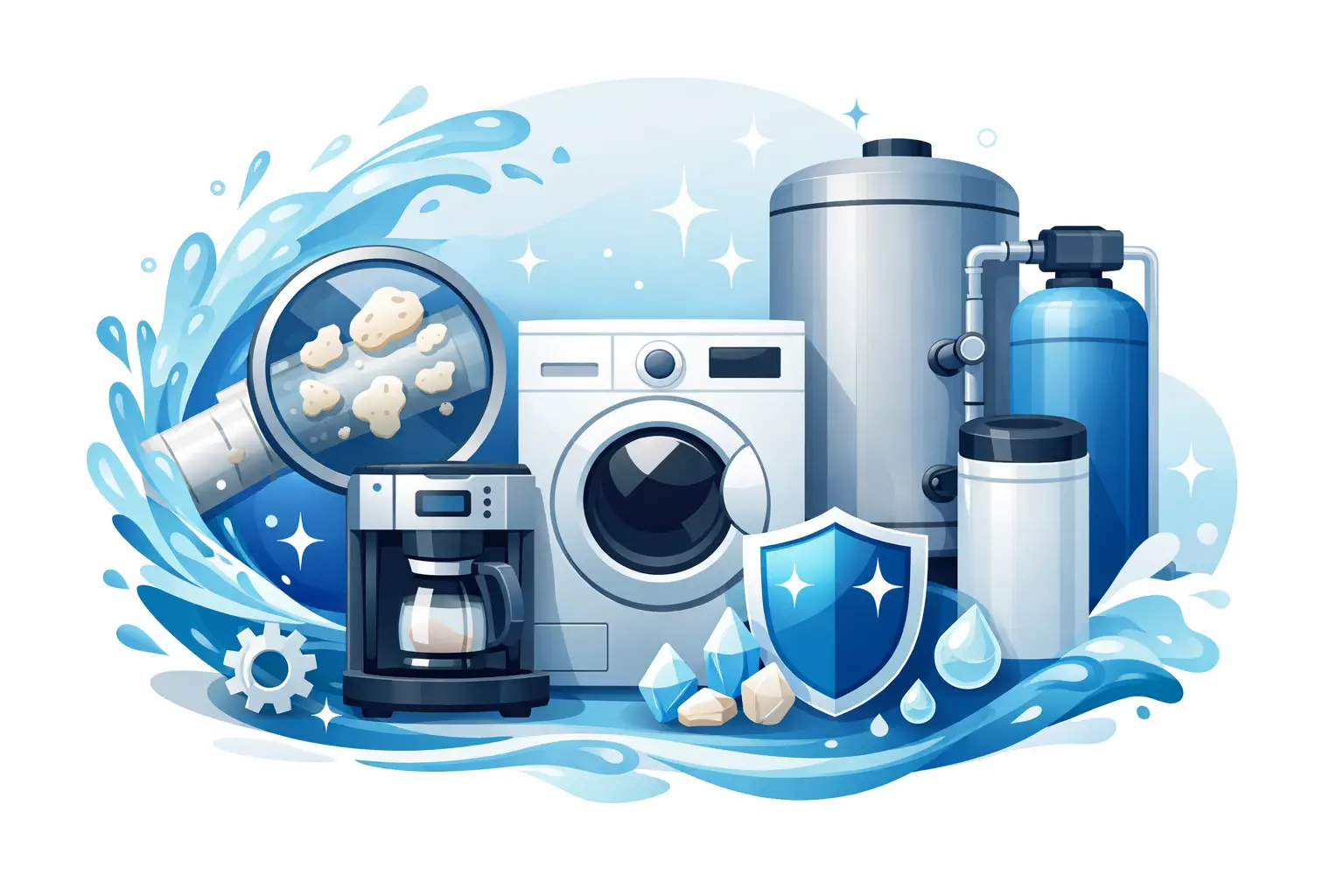
A water heater can lose efficiency long before it fails. The usual cause is mineral scale: a hard, chalky buildup that settles inside tanks, coats heating elements and restricts water flow. Effective appliance scale prevention solutions address the minerals in your water before they have a chance to damage the equipment your home or facility depends on.
For Ontario homeowners, scale is often first noticed as white residue on faucets, cloudy glassware or a kettle that needs constant cleaning. Behind the scenes, the same calcium and magnesium deposits may be shortening the working life of dishwashers, washing machines, coffee equipment, tankless water heaters and boilers. The right treatment depends on your water hardness, water source, daily consumption and the equipment you need to protect.
What scale does to appliances
Hard water contains dissolved calcium and magnesium. These minerals are not usually visible when water comes from the tap. Once water is heated or evaporates, however, they are left behind as scale. Hot-water equipment is particularly vulnerable because heat speeds up mineral precipitation.
A layer of scale acts as insulation on a heating element or heat exchanger. Your appliance needs more energy to heat the water through that barrier, which can increase operating costs and reduce performance. In a tankless water heater, scale can narrow internal passages, reduce flow and lead to more frequent servicing. In a conventional water heater, sediment and mineral accumulation can contribute to noise, uneven heating and premature component wear.
Dishwashers and washing machines face a different set of problems. Scale can affect spray arms, hoses and internal components, while hard water makes detergents less effective. That often means more spotting on dishes, stiffer laundry and a greater need for cleaning products. In commercial settings, the impact can be more expensive: scale on boilers, steam equipment, ice machines, combi ovens and commercial dishwashers can interrupt operations and add avoidable maintenance costs.
Appliance scale prevention solutions start with water testing
There is no responsible one-size-fits-all answer to scale. Water that is moderately hard may need a different approach than very hard well water with iron, manganese, sulphur or bacteria concerns. Municipal water and private well water also present different treatment considerations.
A proper water analysis identifies hardness levels and checks for other issues that can affect treatment design. Iron, for example, may stain fixtures and foul softening media. Acidic water can be corrosive even when hardness is low. High flow demand in a large household, rental property, hotel or healthcare facility can require equipment sized well beyond a standard residential unit.
Testing first helps avoid two common mistakes: installing a system that is too small for the building, or choosing a scale-control device when full water softening is actually needed. Canadian Smart Home Solutions can assess the water and recommend a system based on the source, water use and the appliances you want to protect.
Water softeners: the most complete hard-water treatment
For many homes with hard water, an ion-exchange water softener is the most reliable option for preventing scale throughout the plumbing system. A softener replaces hardness minerals with sodium or potassium ions, significantly reducing the calcium and magnesium that form deposits.
Because it treats the water entering the home, a properly sized whole-home softener protects more than one appliance. It helps reduce scale in water heaters, showers, faucets, dishwashers, washing machines and plumbing lines. Families commonly notice easier cleaning, softer-feeling laundry and less soap residue as well.
There are practical considerations. Conventional softeners require salt or potassium chloride and periodic replenishment. They also need correct programming based on water hardness and household water use. In Ontario, installation should account for local plumbing requirements and the available drain location. These are manageable requirements, but they are reasons to work with an experienced installer rather than treating sizing as an afterthought.
Potassium chloride can be an alternative regenerant for households that prefer it, although it generally costs more than softener salt. For most customers, the best choice comes down to budget, water chemistry, maintenance preference and the degree of hardness found in the test.
Why sizing matters
An undersized softener may regenerate too often, use more water and salt than necessary, and still allow hard water through during high-demand periods. An oversized system can be an unnecessary expense. Correct sizing considers the number of occupants, bathrooms, appliances, incoming hardness and peak flow rate, not just the square footage of the home.
The same principle is even more important in commercial and institutional properties. A restaurant, school, hotel, nursing home or multi-unit building may need engineered treatment equipment with higher flow capacity, multiple tanks or alternating operation to maintain treated water during regeneration.
Salt-free scale control: where it can fit
Salt-free scale-control systems are sometimes selected when a property owner does not want to add salt, does not have a convenient drain connection or only needs protection for specific hot-water equipment. Many of these systems use template-assisted crystallization or similar technology intended to change how hardness minerals form crystals. The minerals remain in the water, but are less likely to adhere as hard scale under suitable conditions.
This option can be useful, but it should not be described as the same as water softening. Salt-free systems do not remove calcium and magnesium. They will not provide the same reduction in soap consumption, spotting or mineral residue on fixtures. Their performance also depends on the incoming water chemistry and the application.
For a homeowner with moderate hardness and a primary concern about scale inside a water heater, salt-free treatment may be worth considering. For very hard water, visible residue throughout the home or a need to improve cleaning results, a properly sized softener is usually the stronger long-term solution.
Point-of-use protection for selected equipment
Whole-home treatment offers the broadest protection, but some properties benefit from targeted equipment protection as part of a larger plan. A scale-control filter, softening system or specialised treatment unit may be installed on a feed line serving a tankless water heater, boiler, commercial dishwasher, espresso machine or ice machine.
Targeted treatment can make sense when only one appliance has a critical scale issue or when a facility cannot immediately upgrade its entire water system. It is also common in commercial kitchens, where high-temperature equipment has demanding water-quality requirements. However, protecting one appliance will not stop scale from accumulating elsewhere in the building.
Reverse osmosis systems are excellent for improving drinking water quality at a dedicated tap, but they are not a replacement for whole-home scale treatment. Likewise, sediment filtration can protect equipment from dirt and particles, yet it does not remove dissolved hardness minerals. Each technology solves a specific problem. Combining the right systems is often more effective than relying on a single filter to do every job.
Maintain the system that protects your equipment
Even the best appliance scale prevention solutions need routine attention. A water softener needs salt or potassium chloride, and its settings should match actual water conditions. Filters need replacement at the recommended interval. UV systems require annual lamp service, while iron removal or well-water systems may need periodic checks to ensure they are operating as designed.
It is also wise to maintain the appliances themselves. Water heaters may need flushing where appropriate, and tankless units may need descaling based on manufacturer guidance and water conditions. Treatment reduces the source of the problem, but it cannot instantly remove years of existing mineral buildup from equipment.
Watch for warning signs that your water treatment needs service: renewed spotting on dishes, reduced water pressure, a sudden increase in salt use, hardness returning at taps, or scale appearing around fixtures. Commercial operators should include water-treatment checks in their preventive maintenance schedule, especially where downtime affects guests, residents, patients or daily operations.
Choose protection based on the whole water picture
Scale prevention is not only about keeping a shower door cleaner. It is a practical investment in hot-water efficiency, appliance reliability, plumbing performance and lower maintenance demands. The best approach may be a whole-home softener, a salt-free scale-control unit, targeted protection for sensitive equipment, or a custom system that also handles iron, sulphur, sediment or other water concerns.
Start with a water test and a clear picture of what your household or facility uses each day. Once the actual water conditions are known, the right treatment can protect the equipment you already own and help it perform the way it should for years to come.