
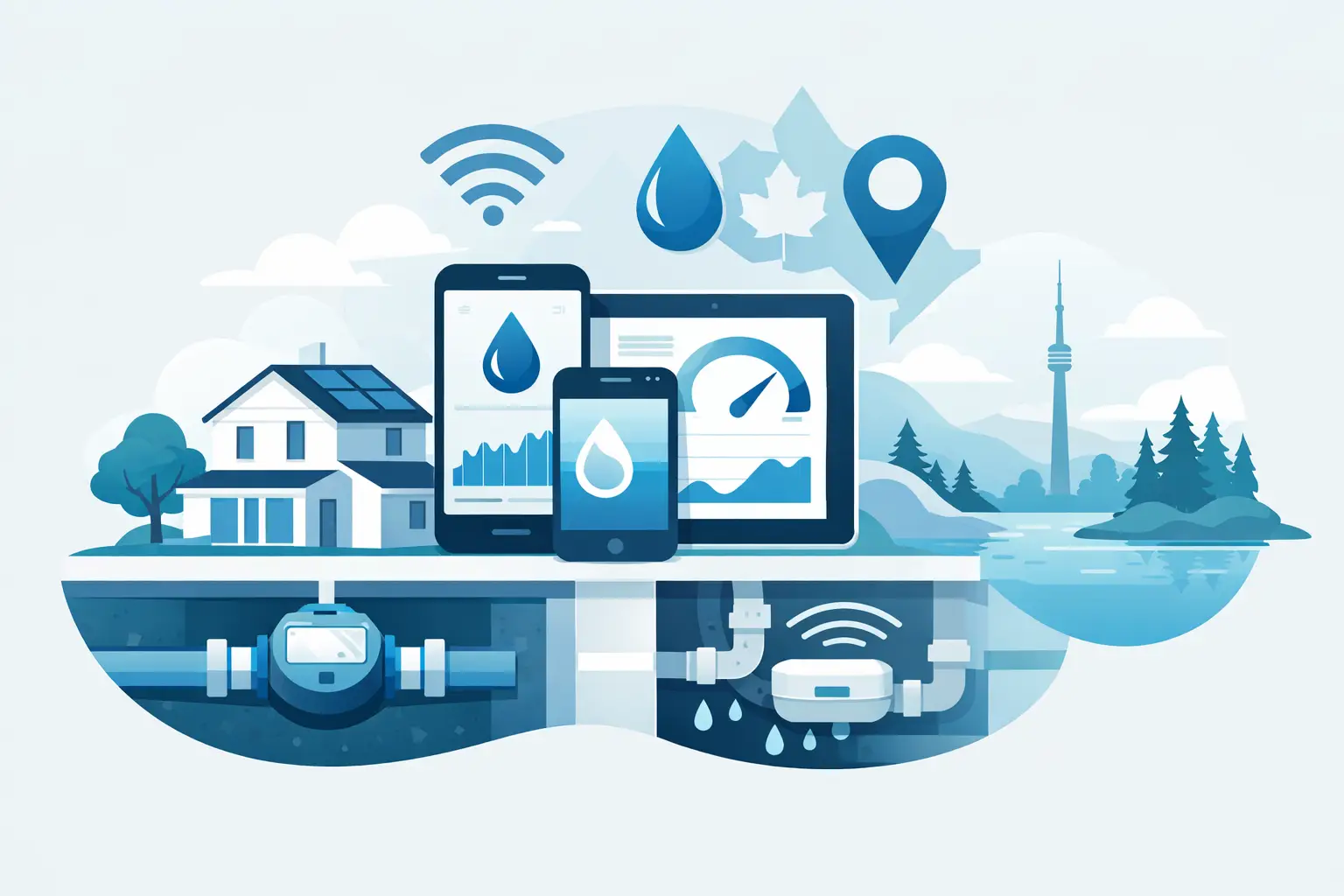
A pinhole leak behind a finished wall can waste thousands of litres before a homeowner sees a stain or a higher water bill. That is why smart home water monitoring trends are gaining attention across Ontario. The strongest systems do more than send an alert to a phone. They help property owners identify abnormal water use early, shut off water during a serious leak, and protect the equipment that depends on a reliable water supply.
For homeowners, this technology can add useful protection to a whole-home water treatment plan. For property managers, hotels, schools, and care facilities, it can provide greater visibility across high-use plumbing systems. But monitoring is not the same as water treatment. A smart device may detect a flow problem, yet it cannot confirm whether water contains lead, bacteria, iron, sulphur, or excessive hardness. Knowing where monitoring helps – and where professional testing and treatment remain essential – leads to better decisions.
Smart Home Water Monitoring Trends That Matter
The most practical trend is the move from basic leak alarms to whole-home flow monitoring. Traditional leak sensors sit under a sink, beside a water heater, or near a washing machine. They are affordable and useful, but they only detect water after it reaches that location. A whole-home monitor is installed on the main water line and watches water flow throughout the property.
When the system sees continuous flow that does not match normal household patterns, it can send an alert. Some models can also work with an automatic shut-off valve to stop the water supply. This matters when a leak begins while residents are at work, away for the weekend, or managing a seasonal property.
The benefit depends on correct setup. A busy household may use water at irregular times, while a home with irrigation, a humidifier, a water softener, or a reverse osmosis system may have normal flow patterns that look unusual to a monitor. Installation and programming should account for the property’s actual plumbing and water-using equipment.
Automatic shut-off is becoming a key feature
Monitoring without action has limits. Phone alerts are valuable, but a homeowner may not see one immediately. Automatic shut-off systems are becoming more common because they can reduce the duration of a major leak, particularly from failed supply lines, burst pipes, toilet overflows, or appliance connections.
This feature requires careful planning. A shut-off event can interrupt water to a building, which may be inconvenient or problematic in a commercial setting. Facilities with fire protection systems, medical needs, commercial kitchens, or continuous operations should have a professionally designed approach that respects code requirements and separates critical systems where necessary.
For a typical Ontario home, an automatic valve can be especially valuable near a finished basement, a mechanical room, or plumbing located behind walls. It is not a replacement for maintaining appliances and replacing aging hoses, but it can reduce the consequences of a failure.
Water-use data is becoming more useful
Another major development is clearer reporting on how and when a property uses water. Rather than showing only monthly consumption, newer monitoring platforms can identify patterns such as overnight flow, repeated toilet refills, prolonged shower use, or unusually high demand after a vacation property is opened.
This information can reveal small losses that would otherwise continue for months. A running toilet, for example, may not cause visible damage, but it can waste a surprising amount of treated water and place unnecessary demand on a well pump, softener, filter system, or septic system.
For larger properties, flow data can help management teams identify areas that deserve attention. A hotel may notice unusual consumption in a particular wing. A school may see water use when the building should be empty. The data does not diagnose every cause, but it gives maintenance staff a useful starting point.
Monitoring Water Quality Has Clear Limits
Interest in smart water quality sensors is growing, especially among families concerned about drinking water safety. Some devices can track measurements such as temperature, conductivity, total dissolved solids, pressure, or changes in flow. These readings may help indicate that something has changed in a system.
However, these devices should not be treated as proof that water is safe or unsafe. A total dissolved solids reading does not identify lead. It does not confirm bacteria, remove hardness, or measure all contaminants that may matter in a private well, lake water supply, or older municipal plumbing system. Clear-looking water can still contain contaminants that require laboratory analysis.
The practical approach is to use monitoring as one layer of protection. If a sensor shows a sudden change, if water develops an odour, if staining appears, or if a household has concerns about lead or well water quality, proper water testing should guide the next step. Treatment should then be selected for the confirmed issue, whether that means a water softener, iron and sulphur removal, ultraviolet sterilization, lead reduction, reverse osmosis, or a whole-home filtration system.
Connected treatment equipment can simplify maintenance
Some treatment systems now offer connected controls or service reminders. These features can be helpful for tracking regeneration cycles in a water softener, filter changes, ultraviolet lamp replacement, or changes in operating conditions. They are particularly useful for landlords, cottage owners, and commercial managers who are not always on site.
The value is not simply convenience. Delayed maintenance can reduce treatment performance and shorten equipment life. A neglected filter may restrict flow. An overdue ultraviolet lamp may no longer provide the expected disinfection performance. A softener that is not operating correctly can allow hard water to return, contributing to scale on fixtures, water heaters, dishwashers, boilers, and other equipment.
Connected notifications work best when they support an established service plan. They cannot replace inspection, water analysis, or a qualified technician’s assessment when performance changes.
Why Ontario Properties Need a Site-Specific Plan
Ontario water conditions vary significantly from one property to the next. Municipal water can present concerns about hardness, chlorine taste, older plumbing, and lead exposure risk in certain buildings. Private wells may require treatment for iron, manganese, sulphur odours, bacteria, hardness, turbidity, or changing seasonal conditions. Lake water systems require their own level of filtration and disinfection planning.
This variation is why a monitor should be installed as part of the larger water system, not purchased as a stand-alone answer to every concern. A main-line monitor should account for a softener’s regeneration cycle. A leak sensor should be placed where appliances, pressure tanks, filters, and water heaters are most likely to create damage. An automatic shut-off valve needs to be accessible and compatible with the plumbing layout.
Cold weather also deserves attention. A monitor may show abnormal flow during a freeze-related plumbing failure, but prevention remains better than response. Insulating vulnerable pipes, maintaining suitable indoor temperatures, winterizing seasonal buildings, and correcting pressure issues are still essential safeguards.
Choosing a Smart Water Monitor
The right product depends on the property and the goal. Before selecting a system, determine whether the main concern is catastrophic leak protection, ongoing water-use visibility, water treatment maintenance, or a combination of these needs.
A homeowner focused on basement protection may benefit most from a main-line monitor with an automatic shut-off valve and a few point sensors near the water heater, laundry area, dishwasher, and bathrooms. A household with a well should also ensure the system accounts for pressure tank operation and any treatment equipment. A commercial facility may need multiple monitoring zones, remote access for maintenance staff, and a more detailed installation review.
Look beyond the app. Confirm whether the device can operate reliably during an internet outage, how alerts are delivered, whether manual override is available, and what happens during a power interruption. Ask about installation requirements, pipe compatibility, warranty coverage, and service support. The least expensive device is not necessarily the best value if it cannot be properly integrated into the building’s plumbing.
Privacy is another consideration. Water-use information can reveal occupancy patterns, so property owners should understand how data is stored and who can access it. Choose equipment from a provider with clear policies and use secure account settings.
A Better Water Strategy Starts With Diagnosis
Smart monitoring gives property owners earlier warning of leaks, unusual use, and equipment concerns. It is a practical addition to a well-managed home or facility, especially where water damage could be expensive. Its greatest value comes when it is paired with accurate testing, properly sized treatment equipment, and professional installation.
If hard water is leaving scale, well water has an odour, fixtures are staining, or drinking water quality is uncertain, start with a clear assessment rather than relying on an app reading alone. Canadian Smart Home Solutions can help Ontario property owners match monitoring, filtration, softening, and purification equipment to the conditions that actually exist in their water and plumbing system. The result should be more than a notification on a phone: it should be dependable water protection that supports cleaner water, longer-lasting equipment, and greater confidence at the tap.