
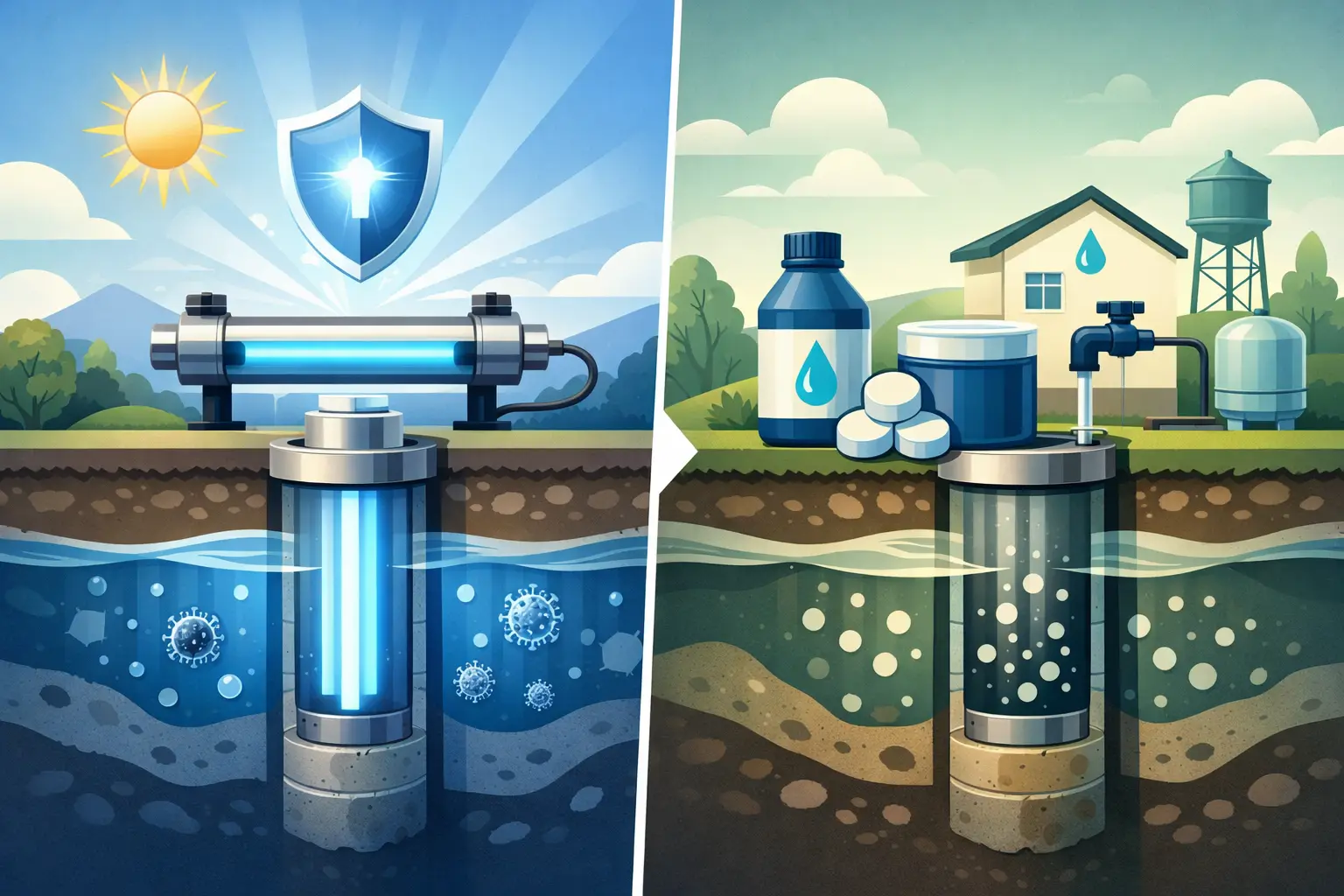
A failed well-water test can turn a glass of water into a serious concern quickly. When comparing uv sterilizer vs chlorine treatment, the right choice is not simply about killing bacteria. It is about the source of contamination, the condition of the water, the required flow rate, and whether your property needs ongoing protection or a corrective treatment process.
For many Ontario homes, a properly sized UV system is the clean, practical answer for continuous disinfection. Chlorine treatment can be the better tool when water has iron bacteria, sulphur odours, recurring contamination, or a need for a disinfectant residual through storage tanks and long plumbing runs. Both can be effective when designed correctly. Neither is a substitute for understanding what is in the water first.
UV Sterilizer vs Chlorine Treatment: The Core Difference
A UV sterilizer disinfects water by exposing it to ultraviolet light inside a treatment chamber. The light damages the DNA of microorganisms, preventing bacteria, viruses, and many protozoa from reproducing. No chemical is added to the water, so there is no chlorine taste, smell, or chemical residual at the tap.
Chlorine treatment uses a metering pump to inject chlorine into the water. The water then needs adequate contact time, usually in a retention tank, for the chlorine to disinfect effectively. Depending on the water conditions and system design, a carbon filter may be added afterward to remove remaining chlorine and improve taste.
The distinction matters: UV works at the point where water passes through the chamber. Chlorine continues working after it is introduced, which is called a residual. That residual can be valuable where water is stored, travels through extensive plumbing, or may be exposed to recontamination downstream.
When a UV Sterilizer Is the Better Choice
UV is often the preferred solution for a private well that tests positive for coliform bacteria or E. coli but does not have major iron, sediment, or odour concerns. It provides continuous treatment without changing the taste of the water or adding chemicals that must later be removed.
For a typical home, a whole-home UV system is installed after the equipment that handles sediment, hardness, iron, sulphur, or other water-quality issues. This placement is essential. UV light needs clear water to work properly. Sediment can block the light, while iron staining, hardness scale, and fouling on the quartz sleeve can reduce the dose reaching microorganisms.
A UV system is particularly appealing when the goal is straightforward microbiological protection. It has a compact footprint, does not require a chemical tank, and does not create a chlorine smell. It can also be highly effective against organisms that are more resistant to chlorine, including Cryptosporidium, when the unit is correctly selected and maintained.
That said, UV is not a catch-all water filter. It does not remove lead, pesticides, dissolved minerals, hardness, iron, sulphur, or sediment. It does not correct a damaged well cap, poor grading around the well, or groundwater entering through a cracked casing. These source problems should be addressed, even when a UV system is installed as an added barrier.
What UV ownership involves
UV maintenance is simple, but it cannot be ignored. Most residential lamps require replacement about once a year, even if the lamp still appears to be glowing. UV output declines over time, and visible light is not proof that the unit is delivering the required germicidal dose.
The quartz sleeve should also be inspected and cleaned or replaced as required. A quality system should be sized for the actual peak flow rate of the home or building, rather than just the number of bathrooms. For commercial properties, high-flow UV equipment, monitoring, alarms, and appropriate pre-treatment are especially important.
When Chlorine Treatment Makes More Sense
Chlorine injection is commonly used for challenging well and lake water, particularly where bacteria are tied to iron, sulphur, slime buildup, or persistent odours. In these situations, chlorine can disinfect the water while also oxidizing certain contaminants so they can be filtered out downstream.
For example, a property with rotten-egg odour, iron staining, and bacterial concerns may need more than UV alone. Chlorine can help oxidize hydrogen sulphide and iron, while a retention tank provides contact time and a backwashing filter removes the oxidized particles. A carbon filter can then polish the water before it enters the home.
Chlorine treatment is also useful for larger facilities with storage tanks, complex plumbing, or long water distribution lines. Because chlorine can leave a controlled residual, it offers protection beyond the treatment equipment. That is a meaningful advantage for applications where water may sit in tanks or travel through areas that cannot be easily monitored.
However, a chlorine system requires more equipment and more attention than a UV unit. The chlorine solution must be kept filled, the injection pump needs servicing, and the feed rate must be set correctly. Insufficient chlorine or contact time can leave water under-treated. Too much can create strong taste and odour concerns, making post-treatment carbon filtration necessary.
Shock chlorination is not a permanent system
Homeowners sometimes confuse shock chlorination with continuous chlorine treatment. Shock chlorination is a one-time sanitizing procedure used to disinfect a well and its plumbing after a contamination event, repair, flood, or bacterial test failure. It can be useful, but it does not guarantee that bacteria will not return.
If repeat tests continue to show bacterial contamination, the well should be inspected and the water chemistry assessed. Ongoing chlorine injection or UV disinfection may be recommended based on the cause and severity of the problem. Repeatedly shocking a well without investigating the source can become expensive and frustrating.
Water Quality Decides More Than Preference
Choosing between UV and chlorine begins with water testing, not equipment preference. A sample that shows total coliform or E. coli tells part of the story, but treatment design should also account for turbidity, iron, manganese, hardness, pH, sulphur, tannins, and flow requirements.
High turbidity can interfere with UV disinfection and make chlorine demand unpredictable. Iron and manganese may coat UV sleeves, stain fixtures, and consume chlorine before sufficient disinfection occurs. Hard water can form scale on equipment. In many Ontario well-water applications, the most dependable answer is a treatment train rather than one standalone device.
A practical sequence may include sediment filtration, iron or sulphur removal, water softening where needed, UV disinfection, and reverse osmosis at the kitchen tap for drinking-water concerns such as dissolved contaminants. In a chlorine-based design, the order may include injection, retention, oxidation filtration, and carbon polishing. The correct sequence depends on verified water results.
Comparing Cost, Maintenance, and Daily Use
UV generally has lower day-to-day complexity. It uses electricity and requires routine lamp and sleeve service, but no chemical handling. It is often the simpler choice for clear well water with a microbiological concern.
Chlorine systems can have higher installation and operating complexity because they may require a chemical solution tank, feed pump, retention tank, and additional filters. In return, they can solve broader water problems and provide residual protection that UV cannot offer.
Neither method should be judged on purchase price alone. An undersized UV system, a chlorine system without adequate contact time, or equipment installed ahead of the necessary pre-treatment can create false confidence. Reliable water treatment depends on correct sizing, professional installation, and service that keeps the system performing as intended.
A Better Decision for Homes and Facilities
Choose UV when your water is already clear, you want chemical-free disinfection, and your main concern is continuous protection against microorganisms at the point of treatment. Choose chlorine when recurring bacteria, iron bacteria, sulphur odours, storage, long plumbing runs, or oxidation needs call for a disinfectant residual and more intensive treatment.
In some properties, the answer is both. Chlorine may be used to address a difficult raw-water problem, while UV serves as a final disinfection barrier after filtration. This approach is common when water quality is variable or the consequences of bacterial contamination are high.
Canadian Smart Home Solutions can assess water results, household or facility demand, existing equipment, and installation conditions before recommending a whole-home or commercial treatment system. The goal is not to sell more equipment than necessary. It is to build a dependable system that delivers cleaner, safer water without adding avoidable maintenance.
If your water has changed in smell, colour, taste, or test results, treat that change as useful information. A proper water analysis and a correctly designed treatment system can turn uncertainty at the tap into dependable water for the people and equipment that rely on it every day.