A private well gives your household independence, but it also makes you responsible for the water entering every tap, appliance, and plumbing fixture. This private well treatment guide helps Ontario homeowners move beyond the guesswork of stained sinks, sulphur odours, hard water scale, or concerns about bacteria and build a treatment plan based on what is actually in their water.
Well water can change with the seasons, heavy rainfall, nearby construction, changes to groundwater, or issues with the well cap and casing. A system that worked well for years may need adjustment when water conditions shift. The right answer is rarely a single filter. It is usually a properly sequenced treatment system designed around your water test, household demand, and specific water quality concerns.
Start With a Complete Well Water Test
Water treatment should begin with analysis, not equipment selection. Clear water can still contain dissolved minerals, bacteria, nitrates, lead, or other contaminants that cannot be seen or smelled. Conversely, orange water may look alarming but be caused primarily by iron, which is often manageable with the right filtration equipment.
For most private wells, testing should assess bacteria, hardness, iron, manganese, pH, alkalinity, total dissolved solids, sulphur or hydrogen sulphide where odours are present, and nitrates or nitrites where relevant. A more detailed analysis may be warranted for arsenic, lead, uranium, sodium, tannins, pesticides, or other concerns based on the property, plumbing, local conditions, and previous test results.
Bacterial testing deserves special attention. Total coliform and E. coli results can indicate a pathway for contamination, such as a damaged well cap, surface water entering the well, poor drainage, or a compromised well casing. Treatment equipment can provide protection, but an underlying well defect should also be investigated and corrected.
A laboratory test is the strongest basis for a system recommendation. Home test strips can be useful as a quick screening tool for hardness or pH, but they do not replace a professionally collected and interpreted water analysis. Retest at least once a year for bacteria and whenever the taste, odour, colour, or clarity changes. Testing after flooding, plumbing work, or a long period of vacancy is also prudent.
Identify the Problem Before Choosing Treatment
A well-water system should solve the problem without adding unnecessary complexity. The most common issues in Ontario homes often occur together, which is why whole-home treatment is frequently more effective than installing one point-of-use filter at the kitchen sink.
Hard Water and Scale Buildup
Hardness is caused mainly by calcium and magnesium. It leaves white mineral deposits on faucets, shower glass, kettles, humidifiers, and inside water-using appliances. Over time, scale can reduce the efficiency and service life of water heaters, dishwashers, washing machines, fixtures, and plumbing components.
A properly sized water softener removes hardness before it travels through the home. Sizing matters. A unit that is too small may regenerate excessively or allow hardness to pass through during peak household demand. A system that is too large can use more salt and water than necessary. Household size, water use, hardness level, and iron content all affect the correct choice.
Iron, Manganese, and Staining
Iron can create orange, red, or brown staining on toilets, tubs, clothing, and fixtures. Manganese often produces darker brown or black staining and can be more difficult to remove. Both may affect water taste and can foul plumbing, softeners, and reverse osmosis membranes if left untreated.
The appropriate solution depends on the form and concentration of the iron or manganese. Sediment filtration may capture particles already suspended in water, while dissolved iron often needs oxidation followed by specialized media filtration. In some cases, air injection, an oxidizing filter, or a chemical feed system is appropriate. Iron bacteria can create slime and recurring odours, requiring a different approach that may include well cleaning or disinfection along with treatment.
Sulphur Odour and Bad-Tasting Water
The familiar rotten-egg smell is commonly associated with hydrogen sulphide gas. It can be strongest when hot water runs, because heat releases the gas more quickly. The odour may originate in the well water, the water heater, or bacteria within the plumbing system.
An odour problem should be diagnosed before selecting equipment. A water heater issue may require maintenance or an anode adjustment, while hydrogen sulphide in the incoming water may call for aeration, oxidation, or specialized filtration. If iron, manganese, and sulphur occur together, a combined treatment system may be more practical than separate units.
Sediment, Turbidity, and Cloudy Water
Sand, silt, rust particles, and other sediment can make water cloudy and wear out fixtures, valves, and appliances. Sediment filtration is often the first stage of a treatment train because it protects downstream equipment. The filter size and micron rating should reflect the amount and type of material present.
A very fine cartridge can improve clarity, but it may plug quickly when sediment is heavy. For properties with recurring sand or high turbidity, a backwashing filter or sediment separator may be a better long-term choice. The goal is reliable flow as well as cleaner water.
Build the Right Private Well Treatment System
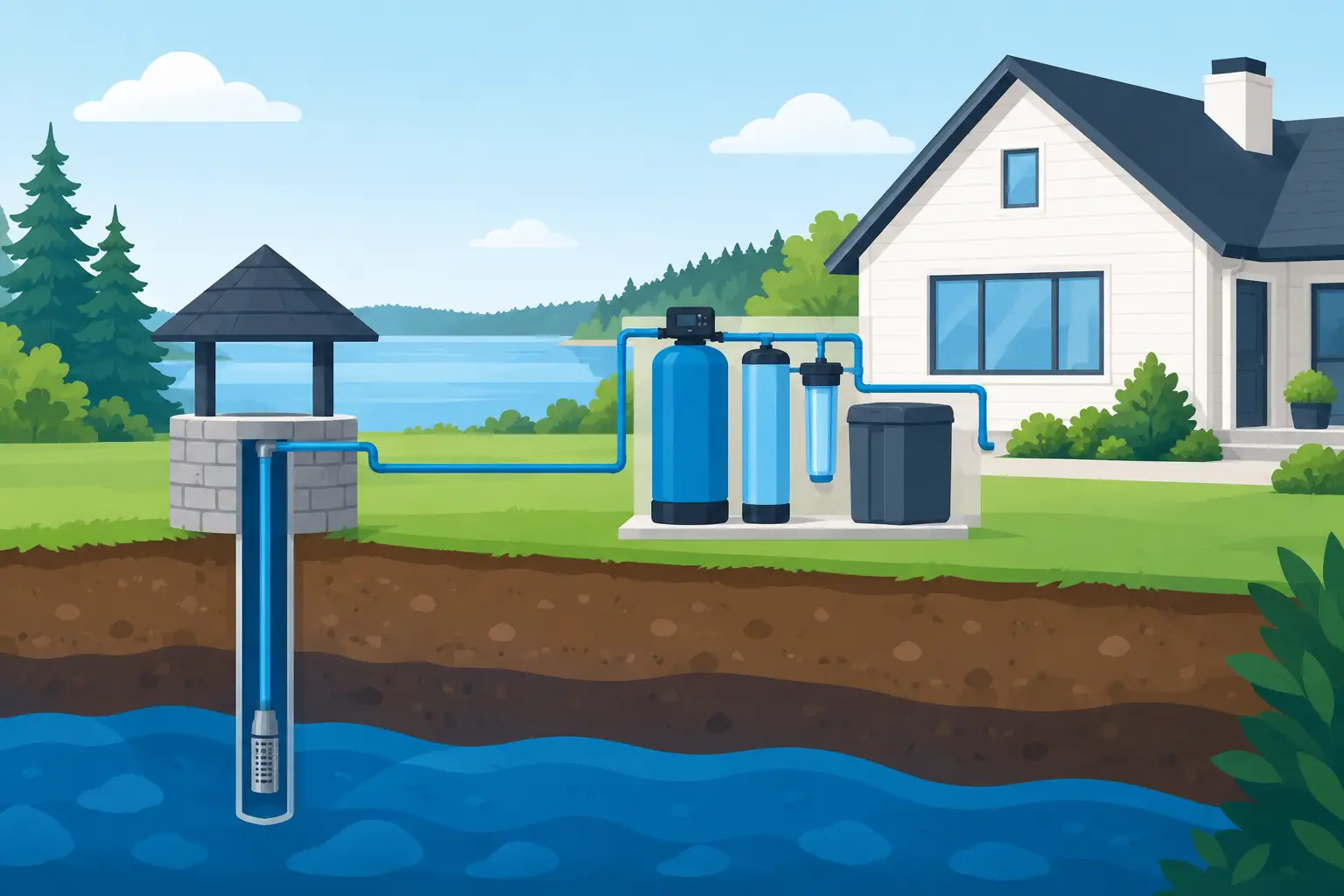
Most well water treatment systems work best in stages. The sequence prevents one issue from undermining the next piece of equipment. For example, sediment should generally be removed before a UV system, because particles can shield microorganisms from ultraviolet light. Iron and hardness removal before reverse osmosis can also protect the membrane and reduce maintenance.
A common whole-home sequence may include sediment filtration, iron or sulphur removal, water softening, and ultraviolet sterilization. A reverse osmosis drinking water system can then be installed at the kitchen sink for high-quality water used for drinking, cooking, coffee, ice, and infant formula preparation.
Not every home needs every component. If the water is bacteriologically safe but hard and high in iron, the focus may be iron removal and softening. If bacteria are a recurring concern, a correctly sized UV sterilizer can provide a valuable final barrier, provided the water is clear enough for UV treatment to work effectively. If lead is a concern from older plumbing components, a certified point-of-use lead reduction solution may be appropriate at drinking water taps.
Flow rate is a critical design factor. A system must keep up when showers, toilets, laundry, and kitchen taps operate at the same time. This is especially relevant for larger homes, homes with multiple bathrooms, and properties with irrigation or high-demand fixtures. Treatment equipment that is undersized can create pressure loss, inconsistent results, and homeowner frustration.
Protect Drinking Water and the Entire Home
A kitchen filter alone may improve taste, but it does not protect shower fixtures, water heaters, laundry equipment, dishwashers, or plumbing from hard water, iron, and sediment. Whole-home treatment addresses water quality at the point where it enters the building, delivering benefits throughout the property.
That said, point-of-use treatment still has a role. Reverse osmosis provides an additional level of purification at the drinking water tap and can reduce a broad range of dissolved contaminants. It is an excellent complement to a whole-home system, not always a replacement for one.
Commercial and institutional well systems require the same disciplined process at a larger scale. Hotels, schools, nursing homes, and other high-use facilities need accurate testing, engineered flow capacity, appropriate disinfection, dependable controls, and a maintenance plan that supports consistent water quality. High water demand makes proper sizing and professional installation especially important.
Plan for Maintenance From Day One
Water treatment is not a set-it-and-forget-it purchase. Filters need changing, softeners need salt, backwashing systems need correct programming, UV lamps need scheduled replacement, and water quality needs periodic verification. Maintenance protects performance and helps identify changes in the well before they become a larger household problem.
Keep a simple record of test results, service dates, filter changes, and any changes in water appearance or odour. If pressure drops, staining returns, salt use changes sharply, or a UV alarm activates, arrange service promptly rather than waiting for the issue to worsen.
Professional installation also matters. Proper bypass valves, drain connections, electrical supply for UV equipment, and plumbing configuration affect both performance and serviceability. An experienced water treatment specialist can size the system for your home, install it cleanly, and explain the maintenance requirements in practical terms.
Canadian Smart Home Solutions helps Ontario homeowners assess well water concerns and install treatment systems that address the full picture, from staining and scale to odours and disinfection needs. The best next step is a current water analysis and a treatment plan built around your actual water, your household, and the protection your property needs.