
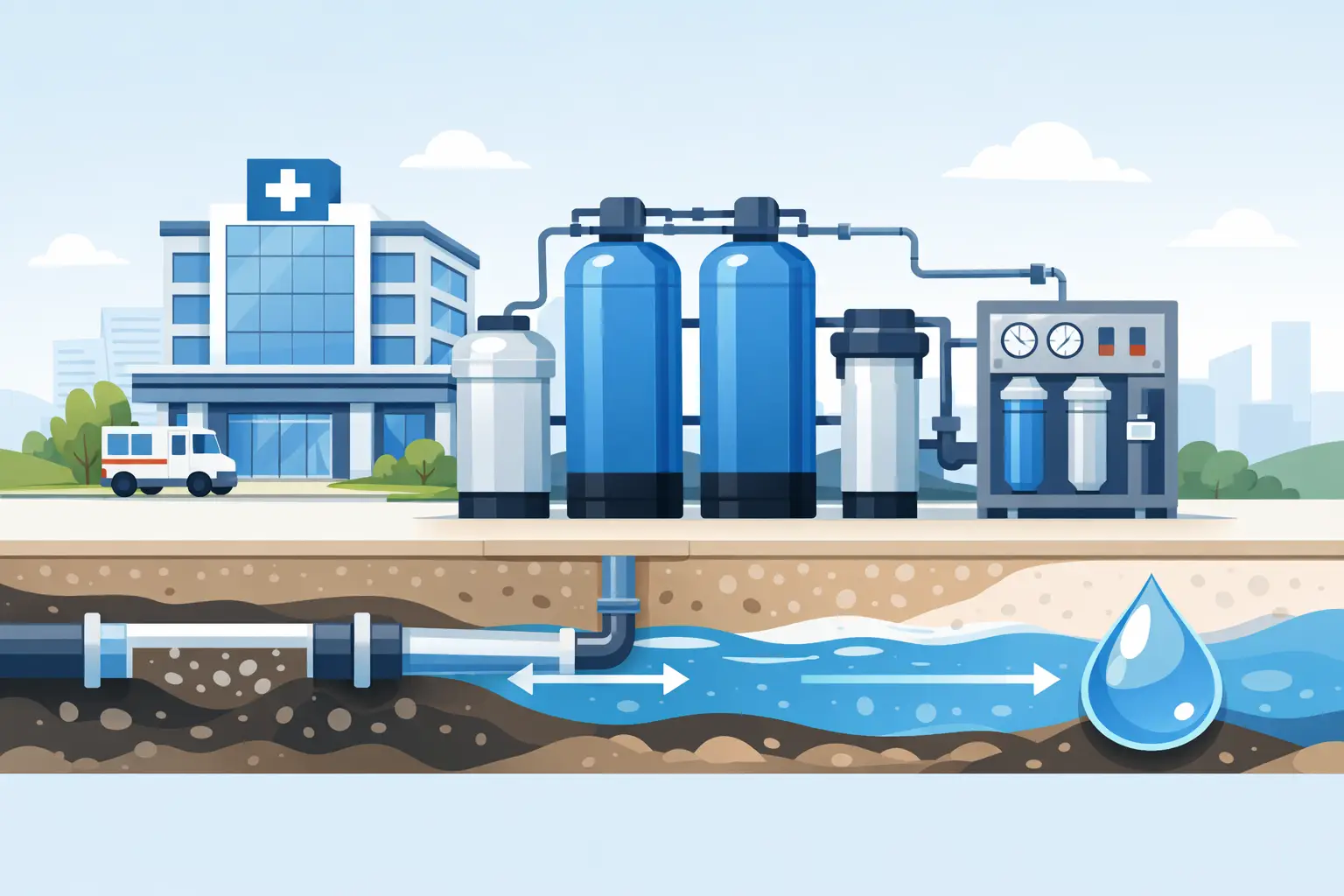
A hospital water filtration example is not simply a large version of a whole-home filter. A hospital’s water system supports patient care, staff hygiene, food service, laundry, sterilization equipment, heating and cooling systems, and sometimes highly sensitive clinical areas. When water quality is inconsistent, the result can be scale damage, poor equipment performance, objectionable taste or odour, and added infection-control concerns.
For Ontario hospitals and healthcare facilities, the right solution starts with understanding where water enters the building, how it travels through the plumbing system, and what each department requires. The goal is not to treat every drop of water the same way. It is to apply dependable treatment at the right point, with enough capacity, redundancy, monitoring, and service access to keep the facility operating.
A practical hospital water filtration example
Consider a mid-sized hospital with municipal water service, several patient floors, a commercial kitchen, on-site laundry, central boilers, cooling equipment, dialysis support areas, and a long-running domestic hot-water loop. The facility has recurring complaints about hard-water scale on fixtures, shortened life of valves and heating components, and sediment collecting in strainers. Its facilities team also wants a stronger approach to water safety management in areas where vulnerable patients may be present.
A practical treatment design could begin with a high-flow sediment filtration system installed after the building’s incoming water meter. This equipment removes suspended solids such as rust particles, sand, and pipe scale before they reach downstream treatment equipment. Choosing the correct micron rating matters. Filtration that is too coarse may allow damaging material through, while filtration that is too fine can create unnecessary pressure loss and frequent filter changes.
From there, the hospital may use duplex water softeners for domestic hot water, laundry, boiler feed, and other equipment-dependent applications. Duplex means two tanks work in sequence, allowing one unit to regenerate while the other continues supplying treated water. In a hospital, continuous service is often more valuable than the lowest initial equipment price.
Carbon filtration may be appropriate where chlorine or chloramine reduction is required for a specific downstream process, taste concern, or equipment application. However, removing a disinfectant residual from water changes the management requirements. Carbon vessels need proper sizing, scheduled maintenance, and a clear plan to prevent stagnation or microbial growth. They are not a universal answer for every hospital water line.
Treatment should follow the water’s use
A hospital has different water-quality targets across the building. General handwashing and washroom water, boiler feed water, kitchen water, ice machines, laboratory equipment, and specialized clinical systems should not automatically receive identical treatment. A site assessment separates these uses and avoids wasting treatment capacity where it is not needed.
Incoming domestic water
At the building entry, sediment filtration protects plumbing and mechanical equipment from particulate matter. If testing confirms hardness at a level that is causing scale, central softening can reduce mineral deposits in hot-water equipment, dishwashers, laundry systems, steam-producing equipment, and fixtures.
Softening does not remove every contaminant. It primarily exchanges hardness minerals, such as calcium and magnesium, to reduce scale. If lead, iron, sulphur odour, organic matter, chlorine by-products, or microbiological risks are part of the water profile, they require separate assessment and treatment methods.
High-risk or specialized outlets
Certain outlets may need point-of-use treatment rather than building-wide treatment. For example, sterile processing, laboratories, dialysis-related applications, and selected clinical areas may require reverse osmosis, deionization, ultrafiltration, ultraviolet treatment, or specialized final filtration. The exact design depends on the equipment manufacturer’s water specifications and the facility’s infection prevention and control requirements.
Reverse osmosis can significantly reduce dissolved minerals and many other contaminants, but it creates a concentrate stream and needs pretreatment to protect its membranes. It is an excellent tool for the right application, not usually the most practical choice for supplying every sink and shower in a large facility.
Final point-of-use filters can add a barrier where water is used by highly susceptible patients or where specific clinical policies call for it. These filters must be selected, installed, labelled, and replaced on schedule. A filter left beyond its service life is not a safety strategy.
Mechanical rooms and equipment protection
Boilers, humidifiers, cooling equipment, commercial dishwashers, and laundry systems often reveal water problems first. Scale acts as insulation on heating surfaces, reducing efficiency and increasing maintenance demands. Sediment can clog valves and strainers. Corrosive water conditions can affect piping and equipment components.
A hospital water treatment plan should therefore include equipment protection as well as drinking-water quality. Pre-filtration, softening, reverse osmosis for selected feedwater, and chemical treatment programs may all have a role. The best combination depends on the system’s flow rate, operating temperature, manufacturer requirements, and incoming water analysis.
Filtration is only one part of water safety
A common mistake is to view filtration as a complete answer to waterborne pathogen control. In healthcare settings, water safety depends on the full system: source water quality, incoming disinfectant residual, pipe condition, storage tanks, hot-water temperatures, flow patterns, dead legs, outlet maintenance, and response procedures.
Legionella management, for example, requires a documented facility-wide approach. Filters and ultraviolet systems may be useful components in specific locations, but they do not replace appropriate temperature control, flushing, cleaning, monitoring, and infection-control protocols. Any modifications to domestic water infrastructure should be coordinated with the hospital’s facilities, clinical engineering, infection prevention, and risk-management teams.
This is also why a central carbon filter requires careful consideration. It can improve water quality for some uses, yet reducing disinfectant residual throughout a large plumbing network may not suit the facility’s water safety plan. The trade-off must be reviewed before equipment is specified.
Capacity, redundancy, and service access matter
Healthcare facilities cannot treat a shutdown as a minor inconvenience. A hospital system should be sized for peak demand, not an average day. Engineers need to consider simultaneous use across patient floors, food service, laundry, mechanical systems, and emergency operations.
Redundancy is equally important. Duplex softeners, parallel filter banks, bypass piping, isolation valves, flow meters, pressure gauges, and automated controls help maintenance teams service equipment without disrupting essential water supply. Where a bypass is installed, it should be clearly identified and managed so untreated water is not unintentionally sent to equipment that depends on treated water.
Service access affects long-term reliability. Filter housings need enough clearance for cartridge replacement. Media tanks need accessible drain connections. Control valves, sample ports, and gauges should be visible and easy to inspect. A technically sound system that is difficult to maintain will eventually underperform.
Start with testing and a site review
No two hospitals have the same water profile or plumbing history. Municipal water chemistry can vary by region and season, while older buildings may contribute sediment, corrosion products, or localized water-quality concerns. Before recommending equipment, collect representative water samples and review available municipal information, building drawings, water-use patterns, pressure, flow requirements, and recurring maintenance records.
Testing should be relevant to the problem being solved. Hardness, iron, manganese, pH, total dissolved solids, chlorine or chloramine residual, turbidity, and microbiological indicators may be considered depending on the application. If lead is a concern, testing must account for where samples are taken and how long water has been sitting in the plumbing.
The findings should produce a clear treatment sequence, not a generic equipment package. Canadian Smart Home Solutions can help Ontario facilities evaluate incoming water issues and specify commercial equipment designed for high-flow, institutional applications.
Ongoing maintenance protects the investment
Every treatment system needs a written maintenance plan. It should define cartridge change intervals, media service requirements, salt delivery for softeners, disinfection procedures where applicable, inspection points, alarms, water testing, and responsible staff. Maintenance intervals should be based on actual water use and measured performance, not only a calendar date.
Documentation matters in a hospital environment. Keeping records of differential pressure, flow, hardness leakage, disinfectant residual, service visits, and corrective actions gives facility managers a practical view of system health. It also helps identify changes before they become equipment failures or operational disruptions.
The most effective hospital water treatment systems are designed around real risks and real demand. When filtration, softening, specialized treatment, and disciplined maintenance work together, the facility gains cleaner water, better protected equipment, and a more dependable foundation for patient care.