
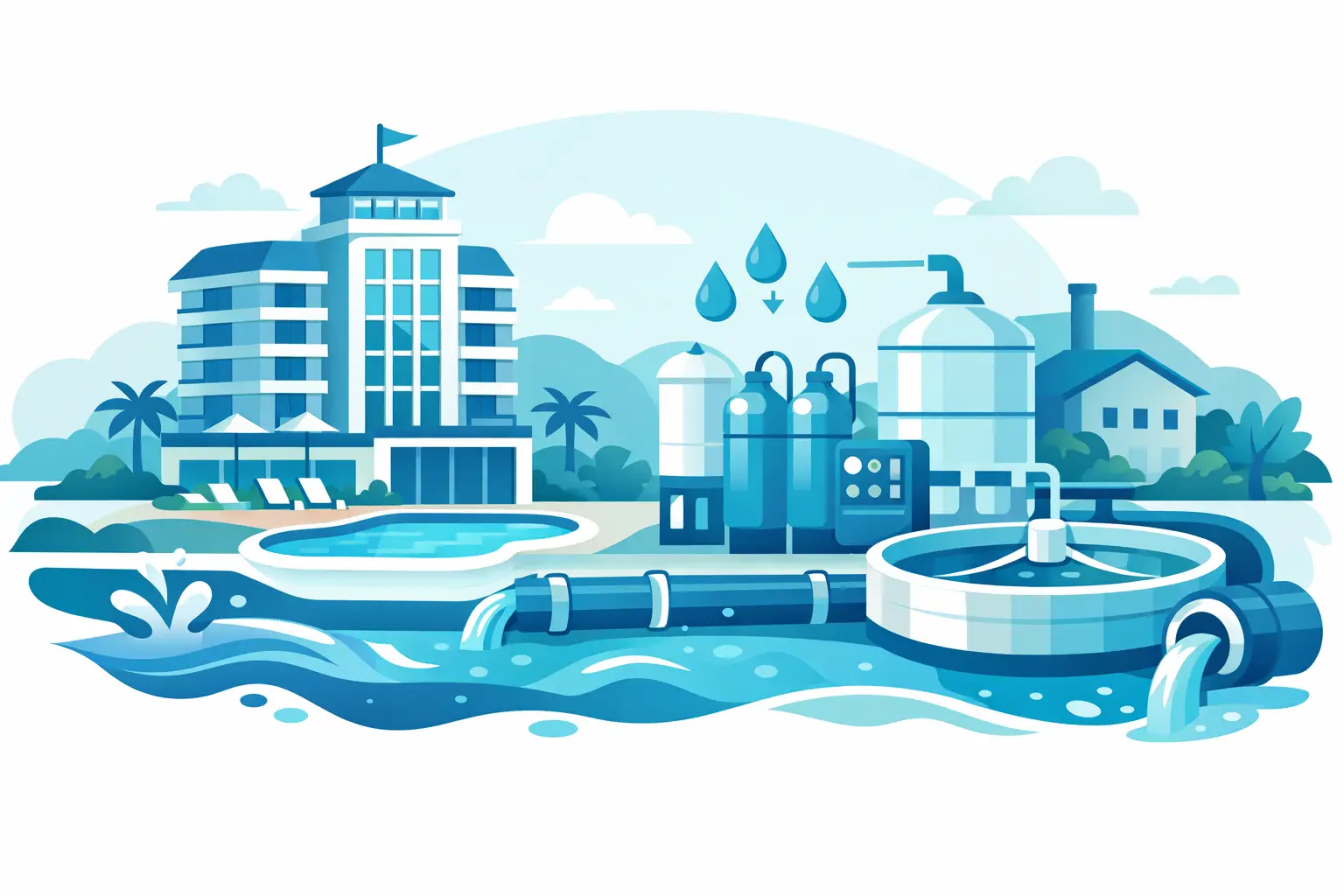
A hotel can use thousands of litres of water before lunch. Guest showers, commercial laundry, kitchens, ice machines, boilers, cooling equipment and housekeeping all depend on a reliable supply. This hotel water treatment example shows why a single filter is rarely enough for a busy property, and how a properly designed system can protect guests, equipment and operating budgets.
Consider a 120-room Ontario hotel supplied by municipal water. Management is receiving complaints about dry skin after showering, white residue on bathroom fixtures, spotty glassware in the dining room and an occasional chlorine taste in drinking water. The maintenance team is also replacing heating elements and repairing valves more often than expected. These are not separate problems. They are common signs that the building’s water quality and water use need to be assessed together.
Hotel Water Treatment Example: Start With the Water Use
The first step is not choosing equipment. It is testing the incoming water and understanding where, when and how the hotel uses it. A system sized for a small restaurant may fail during the morning shower rush at a full-service hotel, even if it appears adequate on paper.
For this example, water testing confirms moderately high hardness, measurable chlorine residual and no immediate microbiological concern in the municipal supply. The property also has high peak demand between 6:00 a.m. and 10:00 a.m., when guests shower, laundry begins and the kitchen prepares breakfast service.
That combination matters. Hard water forms scale inside water heaters, dishwashers, steam equipment and plumbing fixtures. Chlorine can affect taste and odour, and may be undesirable in guest-facing drinking water applications. High demand means the treatment system must maintain pressure and treated-water capacity without creating a bottleneck for the building.
A qualified site review should also look at incoming pressure, pipe size, drain access, electrical requirements, mechanical-room space, existing hot-water equipment and local code requirements. Hotels are not standard residential installations. Commercial systems must be engineered around real flow rates, regeneration cycles and service access.
The Treatment Train for This Hotel
Based on the test results and the hotel’s operating profile, the recommended solution is a staged commercial treatment system rather than one piece of equipment trying to solve every issue.
The incoming line first passes through sediment filtration. Even municipally supplied water can carry fine particles released during water-main work or from aging building plumbing. Removing sediment helps protect valves, softening media, carbon filters and other downstream equipment.
Next, a commercial water softener reduces calcium and magnesium hardness. In this example, a duplex softener is a sensible choice. It uses two tanks that alternate during regeneration, so the hotel can continue receiving softened water when one tank is being cleaned and recharged. A single-tank unit can be appropriate for lower-demand properties, but it may not provide the same continuity during peak use.
After softening, activated carbon filtration reduces chlorine taste and odour. This is especially valuable for guest rooms, restaurant service and ice production. Carbon can also help protect certain equipment and improve the overall guest experience, but it must be properly sized. An undersized carbon filter may reduce chlorine briefly, then allow it through during busy periods.
For the hotel’s drinking-water stations, kitchen beverage service and ice machines, reverse osmosis can provide a higher level of purification. Reverse osmosis reduces a broad range of dissolved contaminants and improves taste. It is not usually necessary to send every litre used for showers and toilets through an RO system. Treating all water with RO would add unnecessary operating cost, wastewater and complexity for this particular property.
The final system may include:
- Sediment pre-filtration to protect downstream equipment
- Duplex commercial water softening for continuous scale control
- Activated carbon filtration for chlorine, taste and odour reduction
- Point-of-use reverse osmosis for drinking water, beverage equipment and ice machines
- UV disinfection where water testing, private supply conditions or building risk assessment call for it
This approach gives the hotel the right level of treatment at each point of use instead of applying the most intensive process everywhere.
Why Softening Delivers a Fast Return
In many Ontario hotels, hardness is the cost driver. Scale acts as insulation on heating surfaces, forcing hot-water and boiler equipment to work harder. It also restricts flow through showerheads, faucets and valves. The visible evidence is frustrating enough, but the hidden equipment wear is often more expensive.
Once the hotel in this example installs commercial softening, housekeeping spends less time removing mineral residue from glass shower doors and fixtures. Laundry can achieve consistent results with less detergent. The kitchen sees fewer spots on dishware, while water heaters and dishwashing equipment are better protected from scale accumulation.
The savings will vary by water hardness, occupancy, equipment type and local utility costs. A softener does use salt and regeneration water, so it is not a maintenance-free solution. However, for a hotel with significant hard-water exposure, those operating costs are often easier to manage than repeated descaling, premature repairs and avoidable energy waste.
Guest Safety Requires More Than a Filter
Water treatment supports guest comfort and water quality, but it is only one part of responsible hotel water management. A softener removes hardness. Carbon improves taste and odour. Reverse osmosis improves drinking water at selected points. None of these systems replaces proper plumbing maintenance, temperature control or a building-specific plan for managing microbial risks.
For a hotel using municipal water, ultraviolet disinfection may not be necessary at every location. It can be valuable where a property has a well, a lake-water source, storage tanks, recurring microbiological concerns or treatment requirements identified through testing. UV systems require clear water and regular lamp or component maintenance to work as intended.
The same principle applies to lead. If testing identifies lead concerns from aging plumbing or fixtures, the solution may involve certified point-of-use lead reduction, pipe or fixture replacement, or a combination of both. Treat the result, not the assumption.
Installation Details That Affect Performance
Even high-quality equipment will underperform if it is installed without enough space, bypass valves, drainage capacity or proper flow control. In a hotel, the treatment system should be accessible for service without disrupting operations. A well-planned installation includes isolation valves, pressure gauges, sample points and clear labelling so the maintenance team can monitor the system confidently.
The softener’s regeneration schedule should be programmed around actual usage, not guessed at. Metered systems regenerate according to water consumption, which can reduce unnecessary salt and water use compared with a fixed calendar schedule. For properties with seasonal occupancy, this adjustment can be particularly useful.
Commercial equipment also needs a realistic maintenance plan. Filters require replacement, softeners need salt, carbon media eventually requires service, and reverse osmosis membranes need monitoring. Neglecting maintenance can reduce water quality, pressure and equipment protection. Ongoing service turns a treatment system from a short-term installation into a dependable part of the building’s infrastructure.
When This Example Would Change
Not every hotel needs the same treatment train. A property supplied by a private well may need iron, manganese, sulphur or tannin removal before softening. A lake-water property may require more extensive filtration and disinfection. A boutique hotel with lower demand may not require duplex softening, while a large convention hotel may need multiple commercial tanks, larger storage capacity and higher-flow filtration.
Water testing provides the starting point, but hotel managers should also consider occupancy patterns, future expansion, laundry volume, food-service operations and the condition of existing plumbing. The correct design balances capital cost, operating cost, guest expectations and equipment protection.
For hotel owners and managers, the most useful next step is a water analysis paired with a site-specific flow assessment. It replaces guesswork with a practical plan – and gives the property a clearer path to cleaner water, fewer maintenance headaches and a better stay for every guest.