
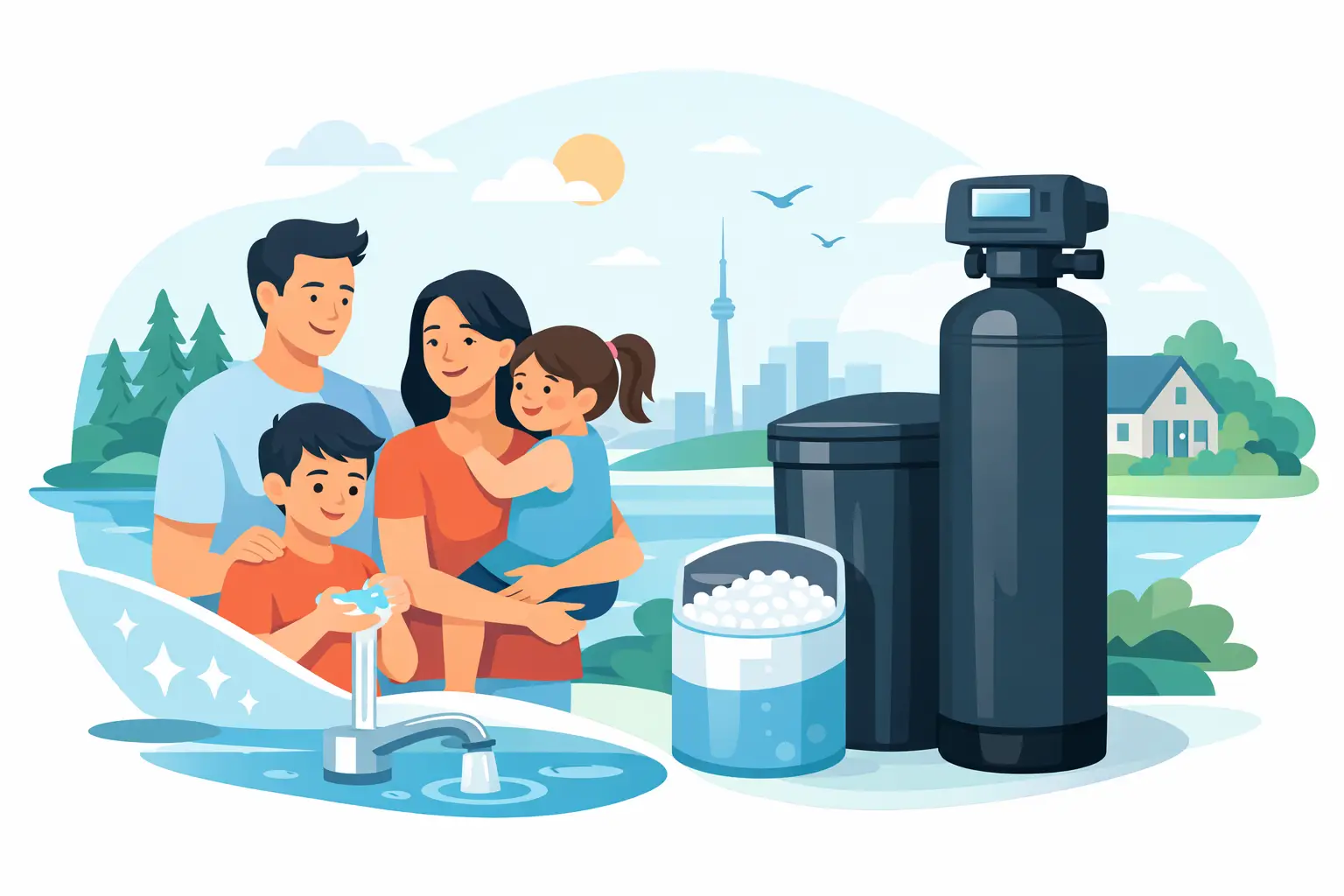
A family of five can expose a water softener’s limits quickly: morning showers, dishwasher cycles, laundry, and a busy kitchen faucet can all run within a few hours. The best water softener for families is not simply the largest unit available. It is the system sized to your actual water hardness, peak demand, plumbing flow rate, and household routine – then installed correctly to protect fixtures, appliances, and water-using equipment.
For Ontario homeowners, this decision often starts after familiar signs of hard water become difficult to ignore. White scale builds around faucets and showerheads. Glassware comes out cloudy. Soap does not lather as expected. Skin and hair may feel dry after bathing, while water heaters, dishwashers, humidifiers, and washing machines work harder than they should.
What Makes the Best Water Softener for Families?
A properly selected water softener removes hardness minerals, mainly calcium and magnesium, through ion exchange. Hard water enters a mineral tank filled with resin beads. The resin captures hardness minerals and exchanges them for sodium or potassium ions. At intervals, the system regenerates using salt or potassium chloride, flushing the captured minerals to a drain and restoring the resin.
For a family home, the quality of that process depends on capacity and control. A system that is too small will regenerate too frequently, use more salt and water than necessary, and may allow hard water through during high-demand periods. An oversized system can cost more up front and may not operate as efficiently as a correctly sized model.
The strongest choices for family use generally include a high-efficiency resin tank, a demand-initiated control valve, adequate flow capacity, and a reliable bypass valve. Demand-initiated regeneration matters because it tracks water use and regenerates based on actual demand instead of a fixed calendar schedule. That helps reduce unnecessary salt consumption while maintaining consistently soft water.
A family-sized softener should also be practical to service. Salt loading, maintenance access, drainage, and placement all affect the ownership experience. A dependable unit installed in the wrong location, or connected to inadequate plumbing, will not deliver its full benefit.
Start With Water Testing, Not Tank Size
Water hardness in Ontario can vary substantially between municipalities, rural properties, and private wells. Municipal water may be treated and safe to drink but still contain enough hardness minerals to cause scale. Well water can bring additional concerns, including iron, manganese, sulphur odours, sediment, tannins, or bacteria.
That is why hardness testing should come before choosing a softener. Results should identify hardness in grains per gallon or milligrams per litre, while a fuller water analysis can reveal other conditions that influence treatment design. Iron, for example, can foul softener resin over time. High iron or sulphur levels may require dedicated pre-treatment rather than relying on a standard softener alone.
Water testing also helps separate hardness problems from drinking water quality concerns. A water softener is designed to control mineral hardness. It is not a complete answer for lead, chlorine taste, microbiological contamination, or every dissolved contaminant. Families concerned about drinking water often benefit from pairing whole-home softening with targeted filtration or a reverse osmosis drinking water system at the kitchen sink.
Size the System Around People and Water Use
The number of people in the home is a useful starting point, but it is not the whole calculation. A family with two teenagers, frequent laundry loads, a large soaking tub, and multiple bathrooms will use water differently than a household of the same size with lower daily demand.
A treatment professional will typically consider household occupancy, water hardness, average daily use, fixture count, plumbing size, and peak flow requirements. Peak flow is especially relevant in larger homes. If two showers, a dishwasher, and a washing machine run at once, the softener must deliver sufficient flow without a noticeable pressure drop.
For many families of three to five people, a softener with a resin capacity commonly in the 30,000 to 48,000 grain range may be appropriate. Larger households or homes with very hard water may need 60,000 grains or more. These figures are planning ranges, not a substitute for testing and proper sizing. A 48,000-grain system is not automatically better than a 32,000-grain model if the smaller system is better matched to the home’s actual needs.
The resin volume and control valve quality are often more meaningful than the number printed on a sales label. Some units are advertised using maximum grain ratings that require inefficient salt doses to achieve. Ask about the system’s working capacity and salt efficiency at normal operating settings, not only its highest possible capacity.
Salt-Based, Salt-Free, or Potassium: Know the Trade-Offs
Traditional salt-based ion-exchange softeners remain the most reliable choice when a family needs genuine hardness removal. They reduce the minerals responsible for scale, improve soap performance, and help protect water heaters and appliances. For homes with hard or very hard water, this is usually the most effective long-term solution.
Salt-free systems are often described as conditioners. They may alter how minerals behave and can help reduce some scale formation under suitable conditions, but they do not remove calcium and magnesium from the water in the same way. They are not a like-for-like replacement where clear soft-water performance is the goal. They can be useful where salt discharge restrictions, maintenance preferences, or moderately hard water make conditioning a reasonable compromise.
Potassium chloride can be used instead of sodium chloride in many conventional softeners. It is often considered by households trying to reduce sodium added through the softening process, although it generally costs more than standard softener salt. Families managing sodium intake should discuss their specific water conditions with a healthcare professional and a water treatment specialist. For drinking and cooking water, a separate reverse osmosis system can reduce dissolved minerals and provide another layer of treatment.
Look Beyond the Softener Tank
The best water softener for families often forms part of a complete water treatment plan. Sediment filtration may be needed to protect equipment from sand, silt, or debris. Carbon filtration can improve chlorine taste and odour in municipal water. Well water may require iron removal, sulphur treatment, ultraviolet disinfection, or specialized media before the water reaches the softener.
This sequence matters. Installing a softener ahead of an untreated iron problem can shorten resin life and increase maintenance. On the other hand, installing filtration without addressing severe hardness may leave the home dealing with scale and reduced appliance efficiency.
Consider which water lines should receive softened water. Most homes benefit from softened hot and cold water to bathrooms, laundry, and appliances. An outdoor tap is often left untreated because softened water is unnecessary for gardening and can increase salt use. Whether the kitchen cold-water line is softened depends on the household’s preferences and the presence of a dedicated drinking water system.
Installation Details That Protect Performance
A water softener needs more than a nearby outlet. Proper installation requires an appropriate drain connection, a safe air gap where required, a bypass arrangement, accessible shutoff valves, and enough space for salt storage and service. The system must be sized for the home’s plumbing and installed in a location protected from freezing.
For homes on private wells, the installation should account for pump flow, pressure tank performance, and changing water conditions. For municipal homes, the installer should verify incoming pressure, plumbing layout, and whether other equipment is already in place. A pressure issue or restrictive plumbing line can affect performance even when the softener itself is correctly selected.
Canadian Smart Home Solutions approaches this as a whole-home water treatment decision, using water analysis and installation expertise to match the equipment to the property rather than forcing every home into one standard configuration.
Questions to Ask Before You Buy
Before selecting a system, ask how it is sized for your household, how often it is expected to regenerate, and how much salt and water it uses per regeneration. Confirm its service flow rate, resin type, warranty coverage, and whether the control valve is designed for demand-initiated operation.
Also ask what happens if the water test shows iron, sulphur, sediment, lead, or bacterial concerns. A clear answer should explain whether additional treatment is needed and why. The right recommendation should address the cause of the problem, not just the most visible symptom.
Do not overlook ongoing support. Families depend on water treatment equipment every day, and occasional maintenance is normal. Knowing who can inspect the system, replace filters, troubleshoot a valve, or retest changing well water provides real peace of mind.
A good softener should fade into the background of family life. You notice it in cleaner dishes, softer laundry, less scale around fixtures, and appliances that are better protected from hard-water buildup. Start with a water test, size the system for the way your household actually uses water, and choose installation support that will still be there after the equipment is in place.